
出品人:向玲 / Producer: Xiang Ling
编辑:武晨曦,石安 / Editor: Wu Chenxi,Shi An
▼视频,Video
(全文深度采访见下方文字。视频为4分钟精华版,建议选择1080p高清版本观看)
__________
相识,结伴创业
Meet and start a business together
卜骁骏:我们是在哈佛大学的一个中国学生的party上认识的,因为有共同的课程和爱好,我们就一起做了很多竞赛,一直到后来在纽约工作,我们参与了很多竞赛,所以就干脆在纽约开了一家小的事务所:Atelier Alter Architects,也就是工作室这个级别的。
2009年,我们通过努力,和厦门合力道集团一起赢得了曲靖博物馆等5个场馆的设计权,除博物馆之外还包括城市规划展览馆、美术馆、科技馆和图书馆。为了更好地服务这些项目,我们就回到了中国。回国之后我们陆陆续续又继续在参与各种各样的投标。那时候中国还依然处在经济危机之后基础建设昂扬向上的环境当中,所以我们觉得很幸运,当时能有这样一个设计的土壤给到我们。
张继元:时境对我们来讲是一个可以承载我们独立思考的空间,就像一个桌子一样,它是我们的一个tabula rasa,一个白案,是所有东西开始的matrix。在创办时境建筑之前,我在Cooper Union完成了我的本科,然后在哈佛GSD完成了我的研究生。在Cooper Union的经历对我的整个人生,或者整个职业生涯来说是非常重要的,因为认识了很多改变我命运的人,比如说Raimund Abraham, Dore Ashton还有Lebbeus Woods等等,他们每个人的出现就像一盏明灯一样,在思想和智慧上给了我全新的启蒙和支持。还有我的好朋友mentor Bradley Horn, David Gersten, Davide Grahame Shane,以及很多我需要感谢的人,他们一直都在给我鼓励,慢慢地开启了我所有的建筑的潜能。
我在帮Raimund工作的时候,他一直跟我说,你需要自己独立,不可以老是想着帮别人工作。作为一位建筑师,你要有一个空间去释放自己独立的思想。毕业以后,我们都在大型的企业里工作,但其实跟我们的追求还是有一定的差距。我们还是希望保持思想和创作的独立性,决定要做一些自己相信的东西。
Xiaojun Bu: We met at the party of a Chinese student at Harvard, and because we had the same curriculum and hobbies, we did a lot of competitions together, until we worked in New York. We did a lot of competitions, so we opened a small office in New York: Atelier Alter Architects, at the studio level.
In 2009, we won (in collaboration with Hordor Design Group) the competition to design five cultural venues in Qujing City, including Qujing History Museum, Qujing Library, the Urban Planning Exhibition Hall, the Art Museum, and the Museum of Science and Technology. To better serve these projects, we returned to China from New York. At that time, China was experiencing a flourishing era of construction right after the economic crisis, and we were fortunate to be enough provided with such a tremendous opportunity for our practice.
Yingfan Zhang:Before we started Atelier Alter Architects, I had completed my undergraduate degree at Cooper Union and then my master degree at Harvard GSD. After studying in university, Bu and I both worked in large corporations, but we found there was still gaps between our pursuit and what we were actually doing. We harbored the idea of maintaining our independence in thinking and creation, and therefore we made our minds to do something we really believed in. Atelier Alter Architects thus became a venue to allow us to think independently. It is like a tabula rasa, a matrix where everything begins.
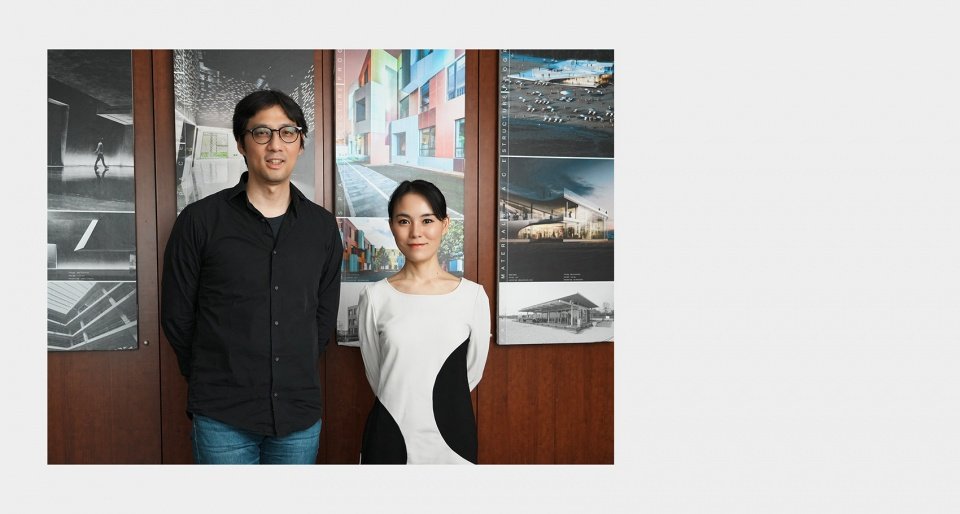
▼卜骁骏和张继元在时境建筑办公室,Yingfan Zhang and Xiaojun Bu in the office of Atelier Alter Architects
_______
北京办公室
The office in Beijing
卜骁骏:我们大约在2011年底从南宁迁往北京,选择这里是因为这里交通非常方便,环境也非常不错。我们最感兴趣的一点是它的社区非常开放,没有任何封闭的印象,加上这里有很多大大小小的企业,所以是一个非常活跃的生态系统。
张继元:(建外SOHO)差不多是北京的脉搏中心,我们当时从纽约回来,就是想感受到国内这种overwhelming的建造环境,跟当地的脉搏一起跳动。这里有意思的地方在于它能够融入各种不同的urban context,它跟胡同、二环这样的context是不太一样的,是另外一个方向上的北京。所以我们其实是没有带任何对文化和场域的理解进来的,就像参与到关于北京的一个matrix里,发现其中各种各样的可能性。
Bu:We moved from Nanning to Beijing around the end of 2011. We chose Beijing because it is very convenient and the environment is very good. One of the things that we’re most interested in is that the community is very open and doesn’t have any impression of being closed, plus there are a lot of large and small businesses, so it’s a very active ecosystem.
Zhang: (Jianwai SOHO) is almost the heart of Beijing. One of the reasons why we came back from New York is because we really wanted to immerse ourselves into this overwhelming construction environment in China and feel the heartbeat of the city. What we found interesting here was that it blends various urban contexts together, and the context is not quite the same as hutongs or the Second Ring Road; it is another direction. When we got back to China, it’s like being in the matrix of Beijing and discover the possibilities that comes with it.
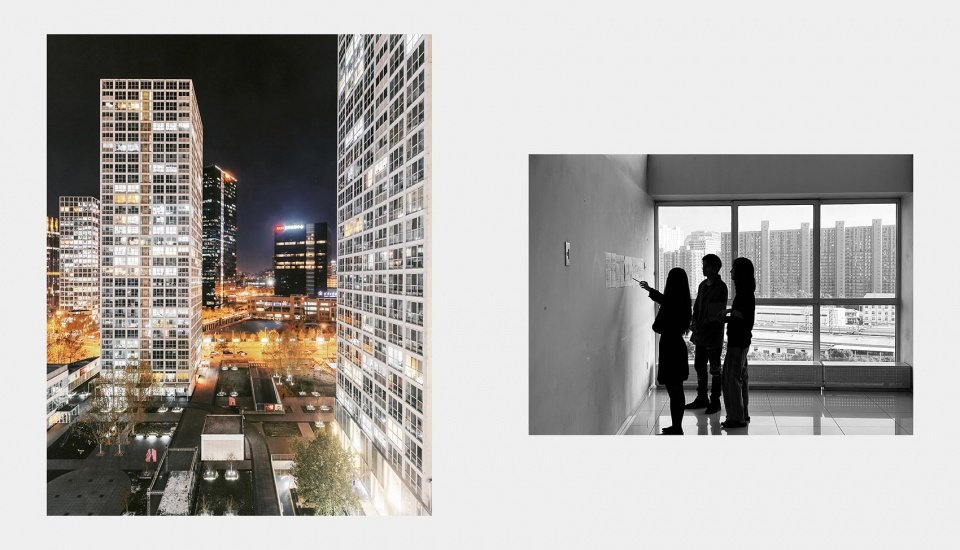
▼时境建筑位于北京东三环建外SOHO,Atelier Alter Architects’s office is located in Jianwai SOHO, Beijing
卜骁骏:在建筑原创的领域里,尤其是我们的新的语言的开拓,基本上是张老师在主导,这是受到张老师的学术思想的影响。关于“如何创作”的问题,我们会批判地推进一个建筑的设计,并且会尽量地绕开已有的成果,这是我们比较自豪的一点。
我们非常感激中国有这样一片建筑实践的沃土,我们从头到尾都觉得非常兴奋。如果我们没有出国的话,可能现在只会去抱怨这个行业的起起伏伏。但如果从一个更大的、全球的角度来看,你会觉得中国市场真的非常“正面”,它能够一直保持一个非常积极活跃的状态。即使到现在,大家都在说“只剩下微小创新”的时代,实际上它依然留给年轻人大量的机会,垂直上升的通道依然存在。很多优质的、公平的竞赛大量地被释放出来,即使你很年轻,也同样拥有设计的权利。这在10年前我们入行的时候是难以想象的,因为那个时候是设计院的天下,并没有给青年建筑师如此透明和公开的竞争机会。所以我们对中国的市场条件一直是怀着感激的心态。
Bu: In the field of architectural originality, especially the development of our new syntax, Yingfan is basically in the lead, which is influenced by Yingfan’s academic thoughts. we take a critical approach to thearchitecture design and try to work around what has already been done, which is something we are proud of.
We feel grateful and excited for China’s fertile ground for architectural practice. If we had not gone out of China, we would probably just be complaining about the ups and downs of the industry. From a larger, global perspective, you will get the sense that the Chinese market is more than “positive” and has been able to stay very active. Even now, when everyone is talking about the era of “tiny innovations”, it still leaves plenty of opportunities for young people to make great achievements. They are exposed to numerous quality, impartial competitions and everyone has the right to design. So we have always been grateful for the market conditions in China.
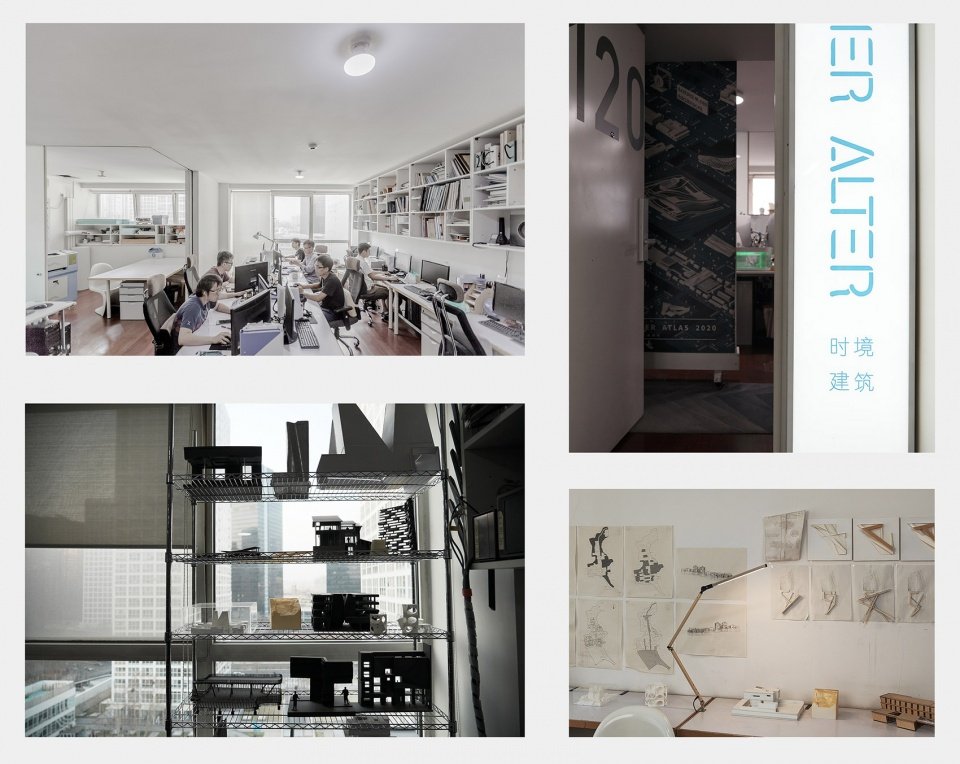
▼时境建筑办公环境,Office workplace
___________________
时境的理念:“运动”与“永恒”
Atelier Alter’s philosophy:“Dynamic”and“Eternity”
张继元:“时境”是时间与空间,我们一直相信建筑是关于时间与空间的再定义或解读。万事万物都有时间性与空间性,而存在的意义在于把握它在时空中的singularity。“存在”有它的瞬时性,以及空间和时间的特殊性。当我们去概括建筑的自由的思想场域的时候,比较重要的是,要把时间与空间的定义涵盖在我们的实践里。
为什么我们不叫“时空”而叫“时境”呢?因为它是对我们中国文化的一个解读,我们觉得“境”包含的意义比“空”可能要更深远一些。“境”对我们来说是一个很神秘的词语,它有很多非线性的、拓扑学的、或是现代科技还没有办法解释的空间领域,所以时境在它开始的阶段就蕴含了“未解之谜”的神秘的意味。
“Alter”指的是变化。一方面我们拥有一种积极的变化,另一方面我们希望创造一种永恒性,它不是传统意义上的永恒,而是处在流动的时间与空间中的永恒。这种基于“瞬间”的、基于singularity的存在,更像是哲学意义而非物理意义上的存在。
Zhang: “Shi Jing” (the atelier’s name in Chinese) refers to time and space, and we have always believed that architecture is a redefinition or interpretation of time and space. Everything has its temporal and spatial dimensions, and the meaning of existence is to grasp its singularity in time and space. “Existence” has its instantaneity and the particularity of space and time. When we generalize the free thought field of architectural ideas, it is even more important to include the definition of time and space in our practice.
Why don’t we call it “temp-spatial (shikong)” instead of “time and space (shijing)”? Because it is our interpretation of Chinese culture, we think the meaning of “space (jing)” may be more profound than that of “spatial (kong)”. “Jing” for us is a very mysterious word, it has a lot of nonlinear, topological, or modern science and technology has no way to explain the space field, so time environment in its beginning stage contains the mysterious meaning of “unsolved mystery”.
“Alter” refers to change. On the one hand, we change in a positive way, and on the other hand, we attempt to create a kind of permanence, not permanence in the traditional sense, but permanence in flowing time and space. This momentary, singularity based existence is more philosophical than physical.
▼时境建筑的部分项目模型,Part of the architectural models by Atelier Alter Architects
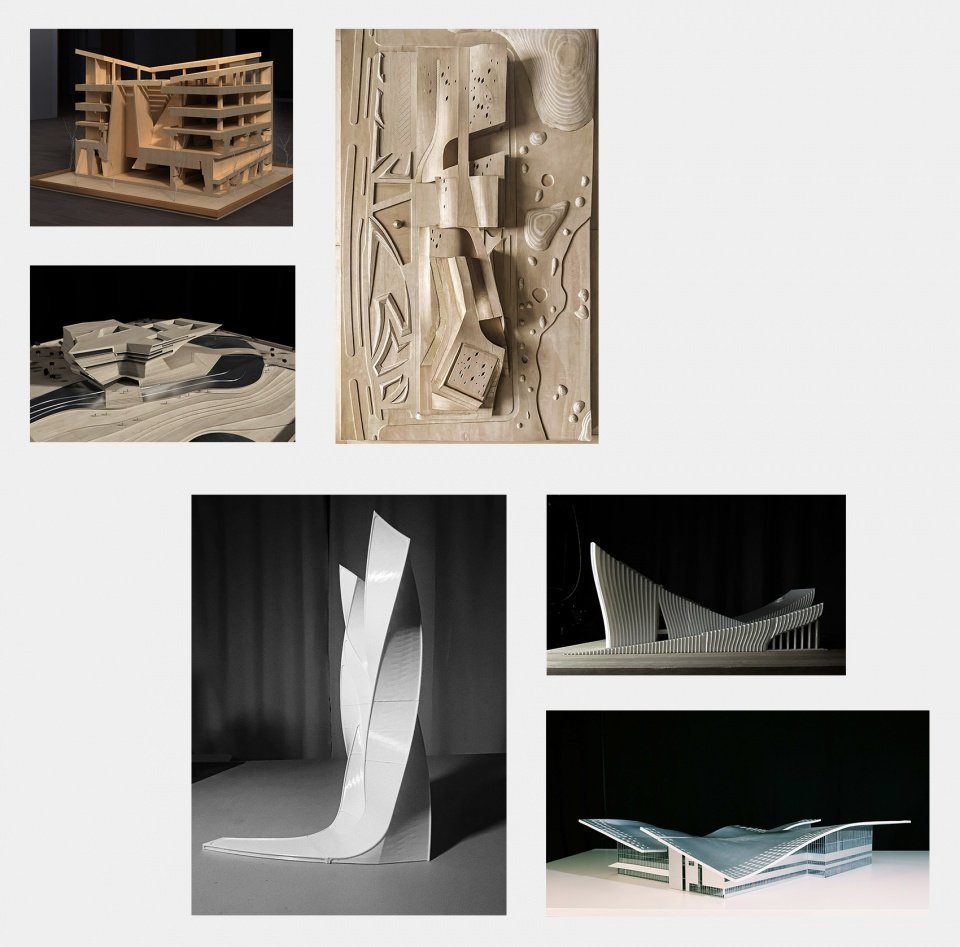
卜骁骏:我们事务所基本处在15人左右的规模。它可能意味着我们不需要在经营上投入太多,同时又能有余力去带领团队进行各种大型项目的尝试。我们的工作基本上都处于项目的头部阶段,后期项目的比例比较少,差不多运行中的十七八个项目里面有三四个在建项目。所以这个体量比较适合公司目前的运作。
时境最不同于其他事务所的地方,我觉得如果用一句话来概括的话,就是我们是在建筑的设计和学术两个领域里进行交叉的运行,我们尤其致力于对新的建筑语言的开拓,这也会解释我们很多的行为:例如我们不会因为有一些代表作而从此就只走这个路子;我们会从很多不同的领域,从学科的交互以及多种文化的可能性当中汲取灵感,也就是再造新的建筑语言,这是我们非常感兴趣的一点。正因为如此,时境的作品也逐渐形成了一种特色,就是你永远都不能清楚地知道我们的下一个作品是什么样子。
Bu: Our firm is basically about 15 people in size. It might mean that we don’t have to invest too much in our operations, while still having the spare capacity to lead our team on various large-scale projects. Basically, our work is in the first stage of the project, and the proportion of late projects is relatively small. Almost 17 or 18 projects in operation and three or four projects under construction. So this volume is suitable for the company’s current operation.
What makes us different from other practices, I think, is that we position ourselves at the intersection of the fields of architectural design and academic fields, and we are particularly committed to pioneering new architectural syntax. This also explains many of our behaviors: for example, we never repeat our previous way of design, in spite of that we do have some representative works; we draw inspiration from different fields, from the interplay of disciplines and from the possibilities of diverse cultures, that is, to re-establish a new architectural language, which is something we are very interested in. This helps us to have gradually developed a characteristic that you could never know exactly what our next work will look like.
▼时境建筑部分代表项目,Part of representative projects by Atelier Alter Architects
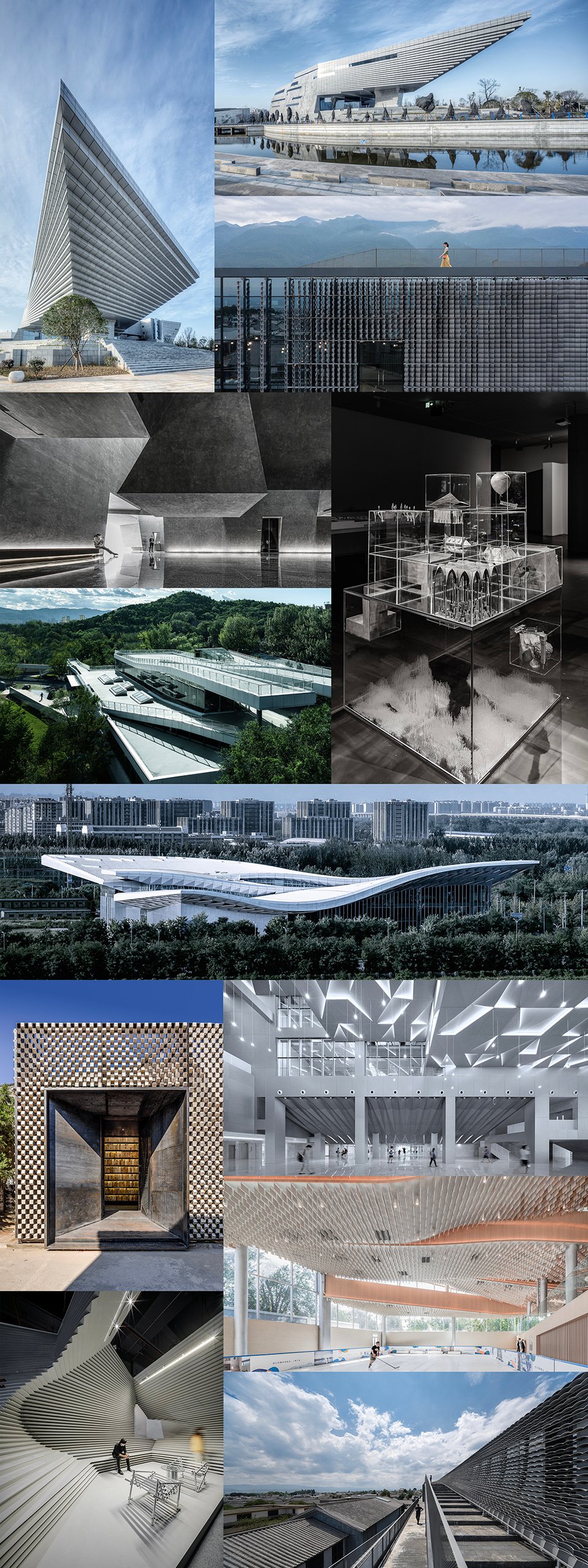
张继元:我和卜老师一起工作了十几年,我们当然是不同的个体,来自不同的教育背景,有不同的思想。一开始我们也是想办法去磨合这些不同,但是到后来我们越来越发现不同是一个很好的东西,就像磁场的两极,由于不同,它能形成各种各样的新的东西。
假设只有一个人带领工作室,那么他或她的思想是很有可能会枯竭。我们从来都有反向地、批判性地看同一个问题的视角,我们要刻意保持不同,但很多时候也是要配合在一起的。通常在开始一个项目的时候我会先介入,定一个大的方向和思路,而卜老师的强项在于如何落地。可以说我是天马行空,但他总是能够让它成为现实。
Zhang: I have been working with Bu for more than ten years, and we are, of course, different individuals, from different educational backgrounds and with different ideas. At the beginning, we also tried to adjust these differences, but later on we found that differences can become a motivator, just like the two poles of a magnetic field. It is the differences that can lead to all kinds of new things.
Assuming only one person leads the studio, it is likely that his or her inspiration will eventually be exhausted. Bu and I are used to looking at the same problem from critical, sometimes opposite perspectives. We need to be different, but very often we also have to work together. Typically, at the beginning of a project, I would be involved in setting a general direction and approach, whereas Bu excels in implementation. Generally, I can be unrestrainedly imaginative, but he is always able to make it a reality.
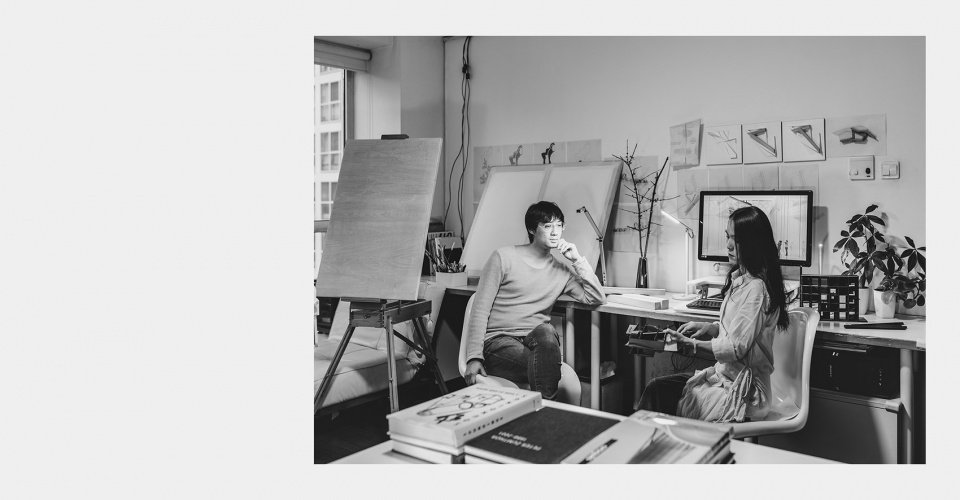
▼卜骁骏和张继元在办公室讨论项目,Bu and Zhang having a discussion on projects in their office
_______
实践
The practice
建筑、结构与哲学的三位一体
Trinity of architecture, structure, and philosophy
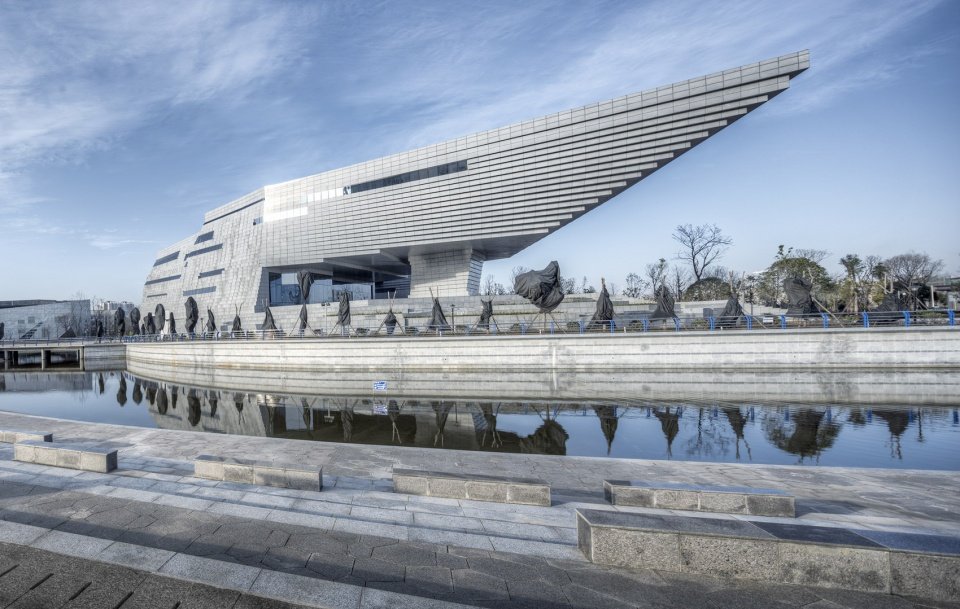
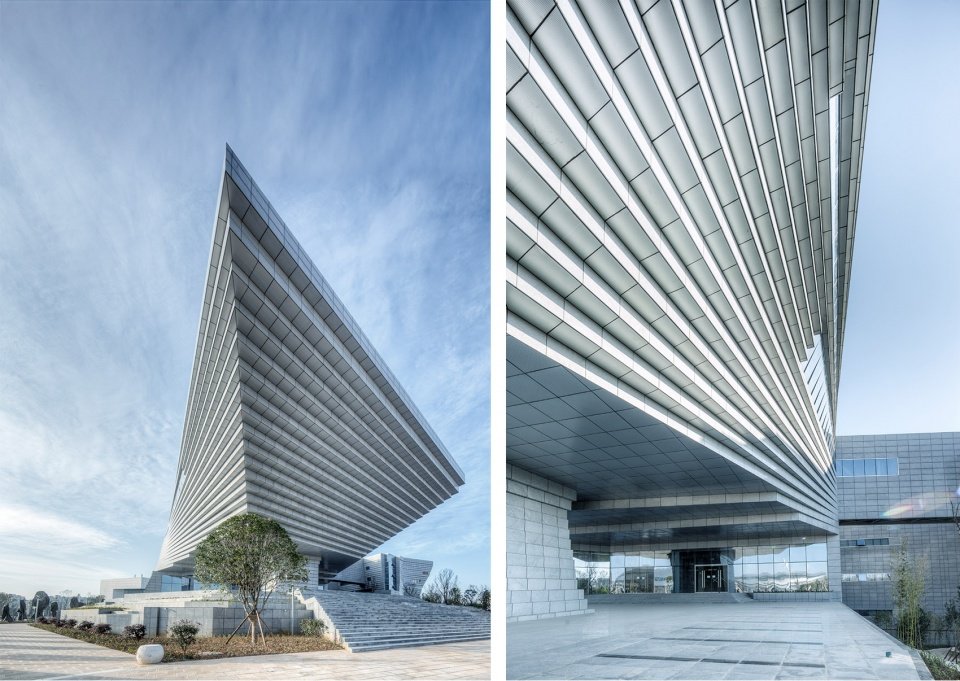
张继元:在当时的环境下,相比于完整地把握一个项目,我们可能只能先去关注它的重点。我们当时抓的重点是“archi-tectonic”,就是它建筑体块的构成。在博物馆这个项目里,我们将一个悬浮的体块和一个向上的体块并置,然后用体块去解读云南当地的文脉,它的梯田,还有梯田与天空的镜像关系。这是非常抽象的一组空间关系,所以我们当时是用建筑体块去破解它的地理,从而再深入到它的人文,希望能够达到地理与人文在建筑中的融合。
Zhang:In the context of that time, we may have to focus on the main points of a project before we can fully grasp it. What we focused on was “archi-tectonic,” the composition of the architecture blocks. In the museum project, we juxtaposed a suspended volume with an upward volume, and used the volume to interpret the local context of Yunnan, the terraces, and the mirror relationship between the terraces and the sky. This is a very abstract set of spatial relations, so we used archi-tectonic to crack its geography, so as to go deeper into its humanity, aiming to achieve the intergration of geography and humanity in architecture.
▼曲靖博物馆,时境在创立初期的代表性项目,Museum for Qujing Culture Center, one of the representative projects from the early years of the atelier
点击这里查看更多,Click HERE for details
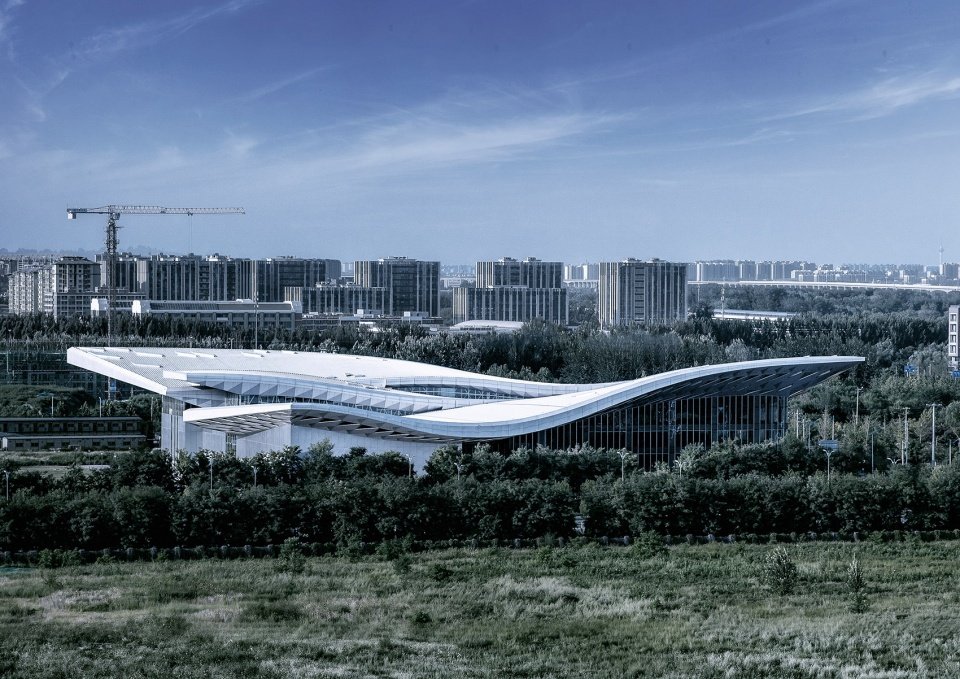
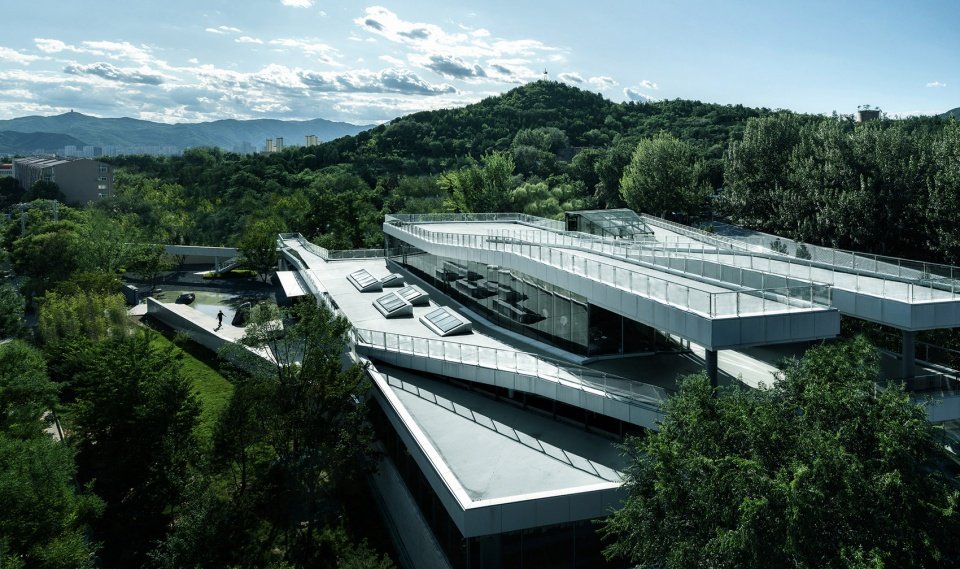
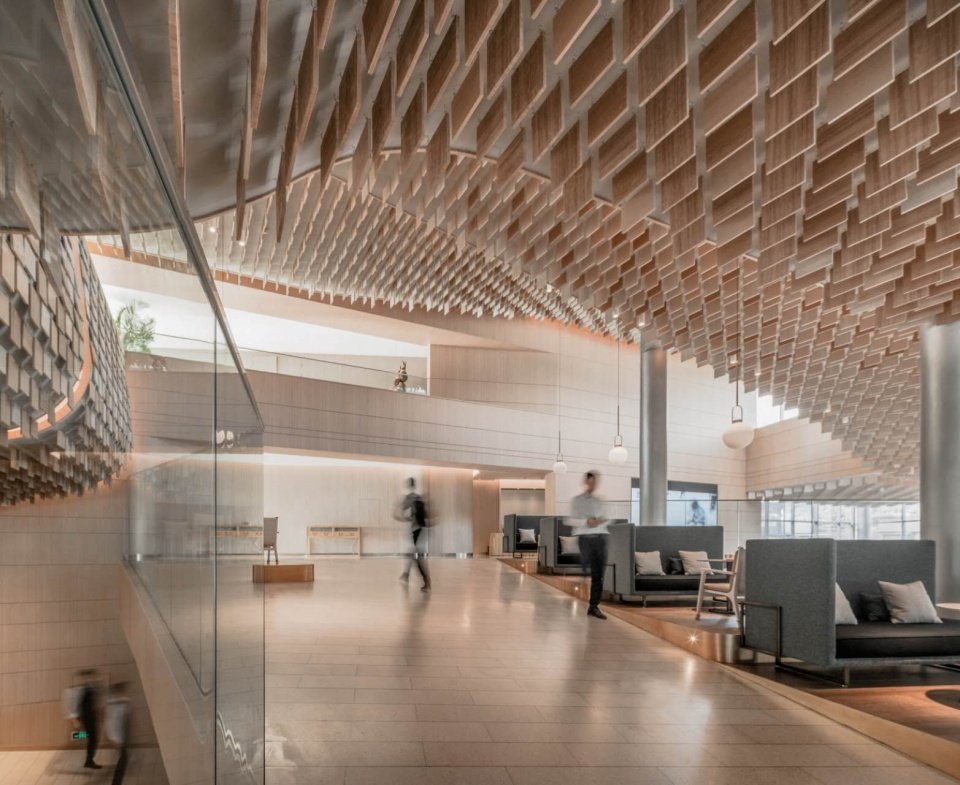
张继元:多年走来,我们做了很多新的文化公建,越往下走就越发现,一开始我们的话语权是非常有限的。而在我们逐步积累经验,对项目的把控力越来越强之后,我们现在能做到让建筑内部的空间功能和空间关系与它外部的构造形成延续性。所以我们当下的目标就是让我们的项目能够在规划尺度、建筑尺度和细部尺度上达到连贯性,达到建筑、结构与哲学的三位一体。
Zhang: We have carried out many cultural public projects over the years, and the further we progress, the more we realize that our voice was very limited in the early period of our practice. But as we gradually accumulated experience and became proficient in controlling the projects,we are now able to ensure that the internal spatial functions and relationships of a building continue externally. So, our current goal is to achieve coherence in planning scale, architecture scale, and detail scale in our projects, reaching the trinity of architecture, structure, and philosophy.
▼功能空间与外部构造的延续性:北京理工大学文体中心,The continuity of functional space and external structure: BIT Sports Center
点击这里查看更多,Click HERE for details
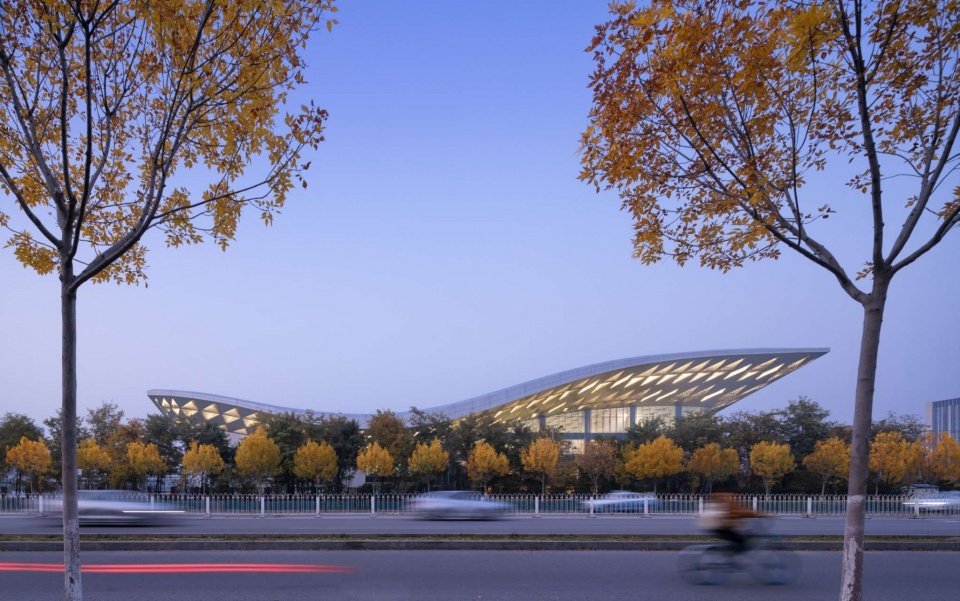
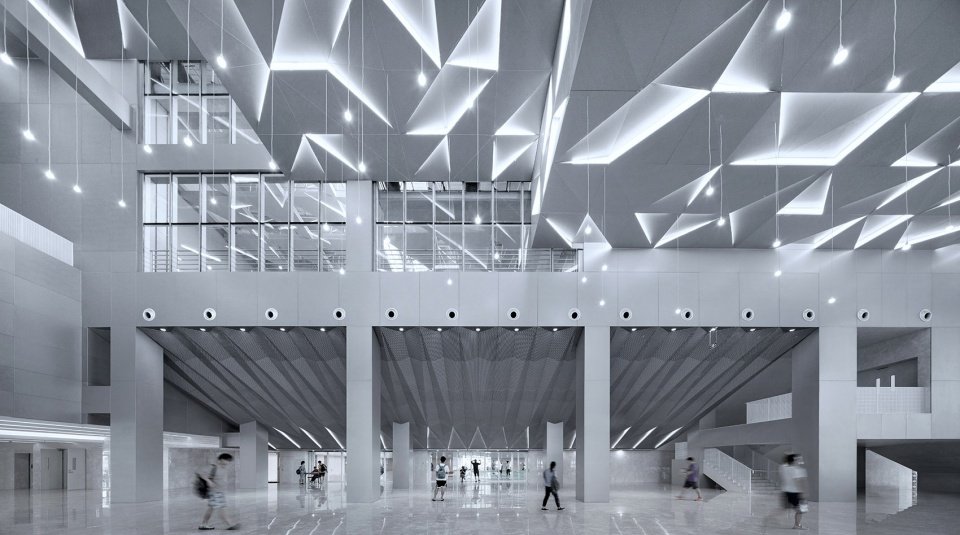
▼功能空间与外部构造的延续性:五里春秋泛文化艺术中心,The continuity of functional space and external structure: WuliEpoch Culture Center
创造新的建筑语言
Creating the new syntax of architecture
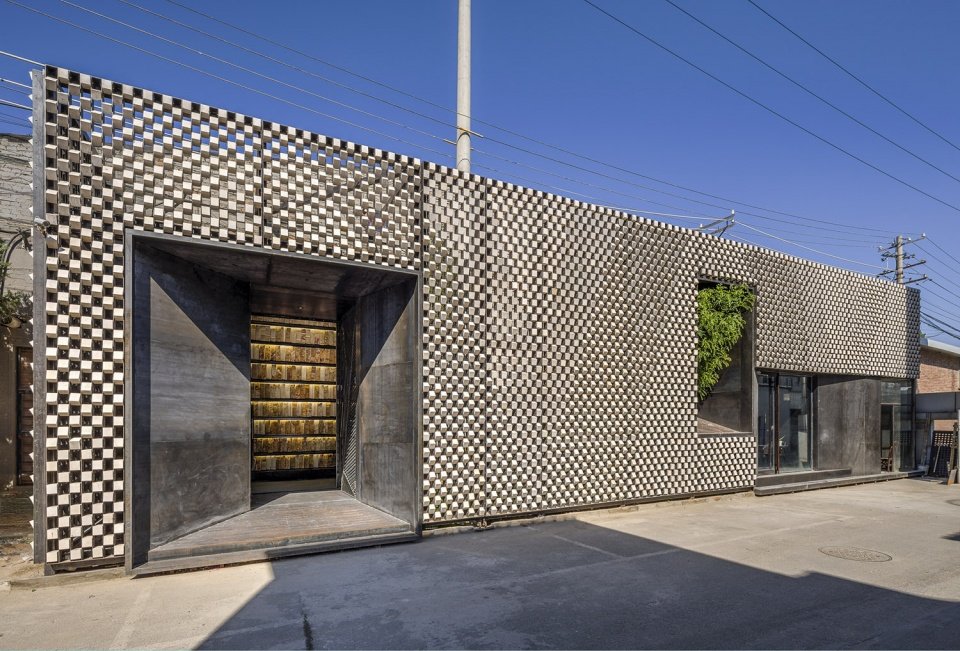
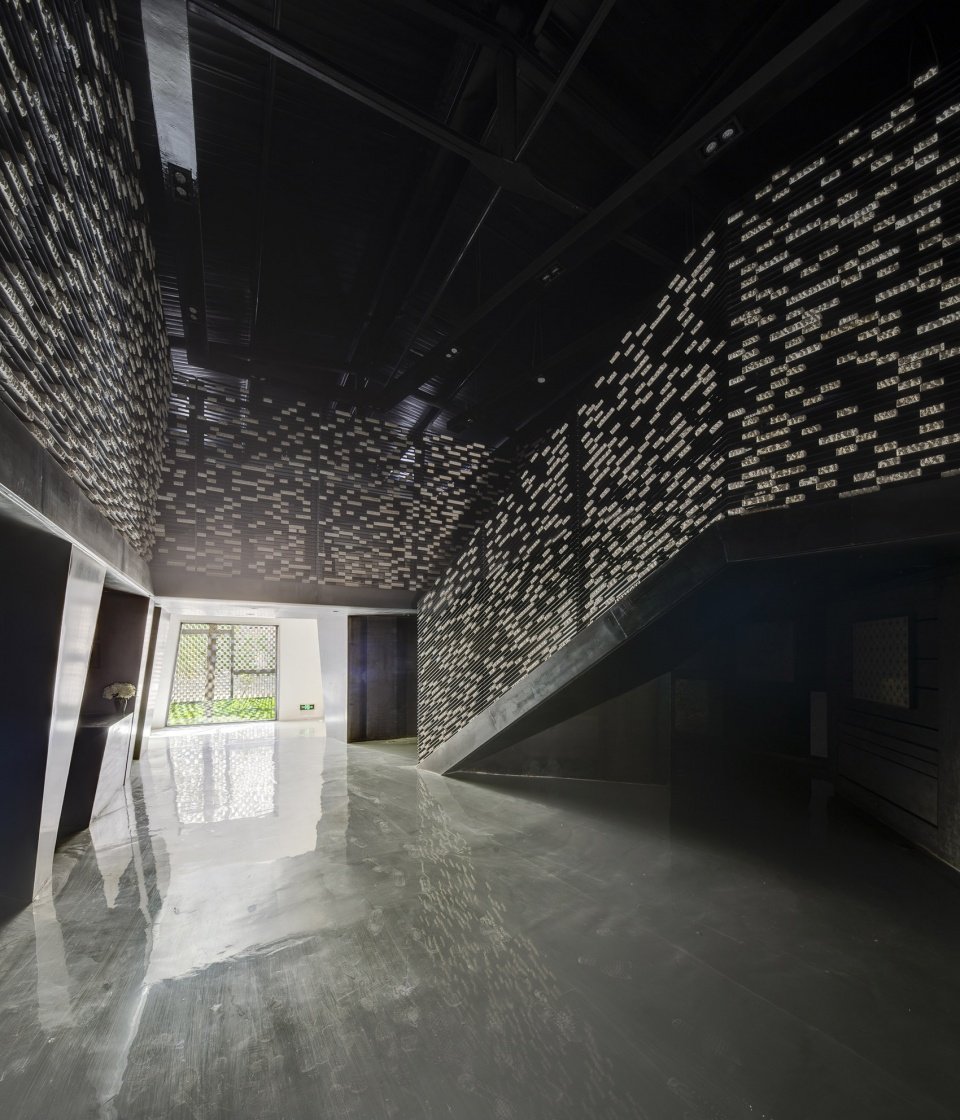
卜骁骏:在英良石材展厅这个项目开始之前我们就已经对石材工业的历史和文化进行了长时间的研究。我们对石材工业人是有感情的,他们开掘石材的过程本身就是非常伟大的行为。在设计第一个英良石材展厅(北京)的时候,我们发现矿坑的巨大尺度与人之间的对抗是一个非常赞的发掘点,此前还没有人从这一点上去找到建筑空间。
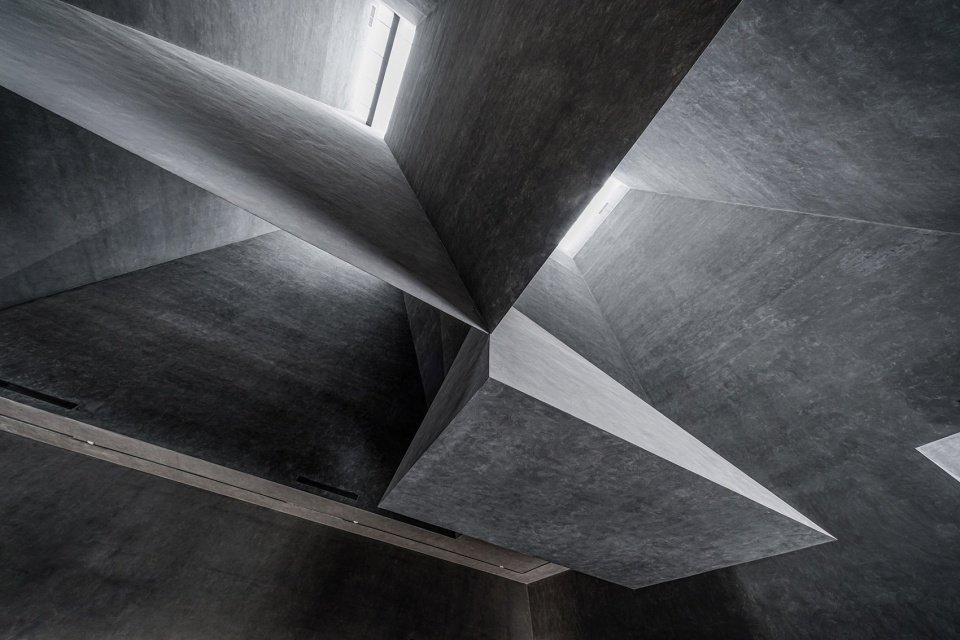
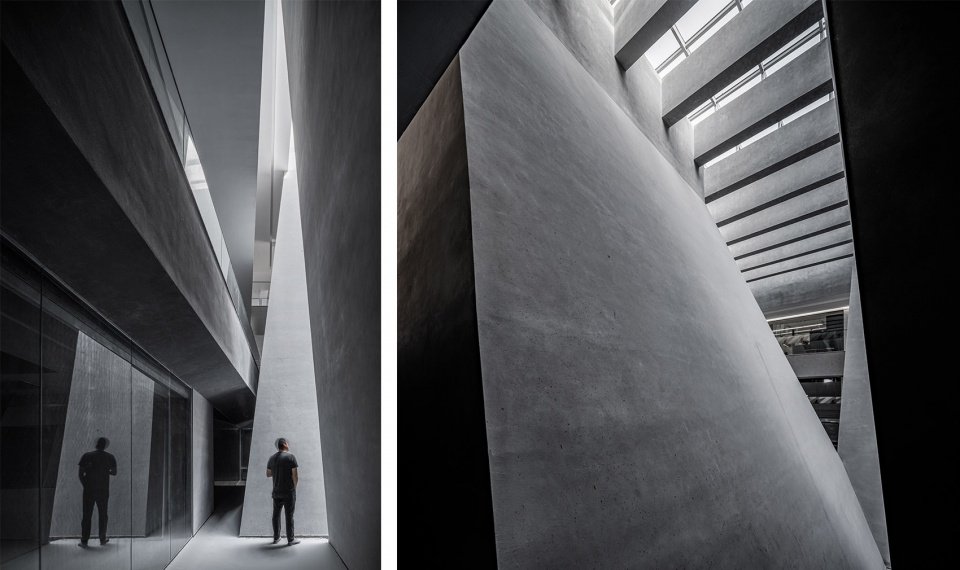
而在福建的博物馆项目里,我们找到了第二个发掘点,就是晶体,因为石材的生成过程存在很多的可能,而其中的重要一条就是融化晶体产生新的石材。人对洞穴的晶体空间的追求实际上是一个原始的本能,而当我们面临巨尺的空间的时候,是一种“失神”的状态,我们认为这有可能反映出石材人站在这个空间中所收获的崇高的感受。
Bu: We had done extensive research on the history and culture of the stone industry before the design of Yingliang Stone Natural History Museum started. We are indebted to the people who work for the industry of stone mining. The process of quarrying is a great act in itself. When designing the Yingliang Stone Archive (Beijing), we found the confrontation between the huge scale of the mine and human beings to be a quite interesting starting point, from which no one had previously attempted to create an architectural space.
For the later project in Fujian, we found the second key point of the design, which is the crystalloids, because there can be various possibilities in the process of stone formation, and one of the important ones is the melting of crystals to become new stones. The quest for the crystalline space of the cave is actually a primitive instinct of human, who become infatuated when facing its gigantic scale, it is a state of “loss of mind”. We believe this may reflect the sense of sublimation that the quarrymen had experienced in this space.
▼北京英良石材展厅,Yingliang Stone Archive, Beijing
点击这里查看更多,Click HERE for details
卜骁骏:如果有可能的话,哪怕是很商业的项目,我们都会尽量从背后去阐释它们的文化历程,还有跟人的精神层面的关系,这是非常重要的。我们最终是要跟人的抽象层面发生直接的关系。比如我们去年为一家芯片公司做的办公楼项目,我们也是从它所从事的晶片行业去寻找硅晶结构的灵感,然后把它释放成一种新的建筑能量。正因为建筑师拥有这样一种导向的权利,所以我们才有可能将人类文明从最原始的状态变成使用空间,变成与普通民众之间发生关系的可能性,这也让我们所从事的职业变得非常有价值。
在材料方面,我们往往会选择一种与项目所在领域比较接近的材料,并且研究它。同时,我们会思考如何挑战这种材料的边界,以及如何将它转译为建筑。
Bu: If possible, even for very commercial projects, we try to interpret the cultural history behind them, and the relationship with the spiritual aspect of people, which is an important part of our method. Ultimately, we want to build a direct relationship with the abstract level of people. For example, in the office building we did for a chip company last year, we also looked for the inspiration of silicon crystal structure from the chip industry, and then released it into a new architectural energy. It is because architects have right to lead the direction that we are able to transform human civilization from its most primitive state into the possibility of using space and interacting with ordinary people, and this makes our profession valuable.
In terms of materials, we tend to choose a material that is closer to the field where the project is located and study it. At the same time, we think about how to challenge the boundaries of that material and how to translate it into architecture.
▼福建英良石材自然历史博物馆,Yingliang Stone Natural History Museum, Fujian
点击这里查看更多,Click HERE for details
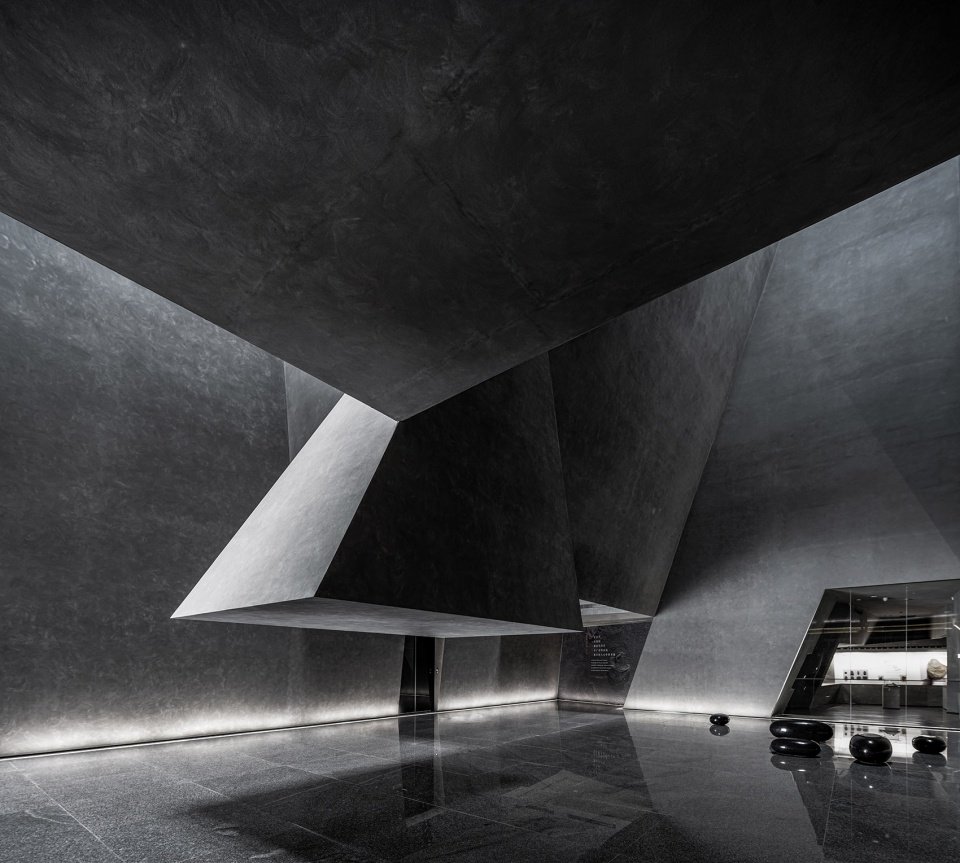
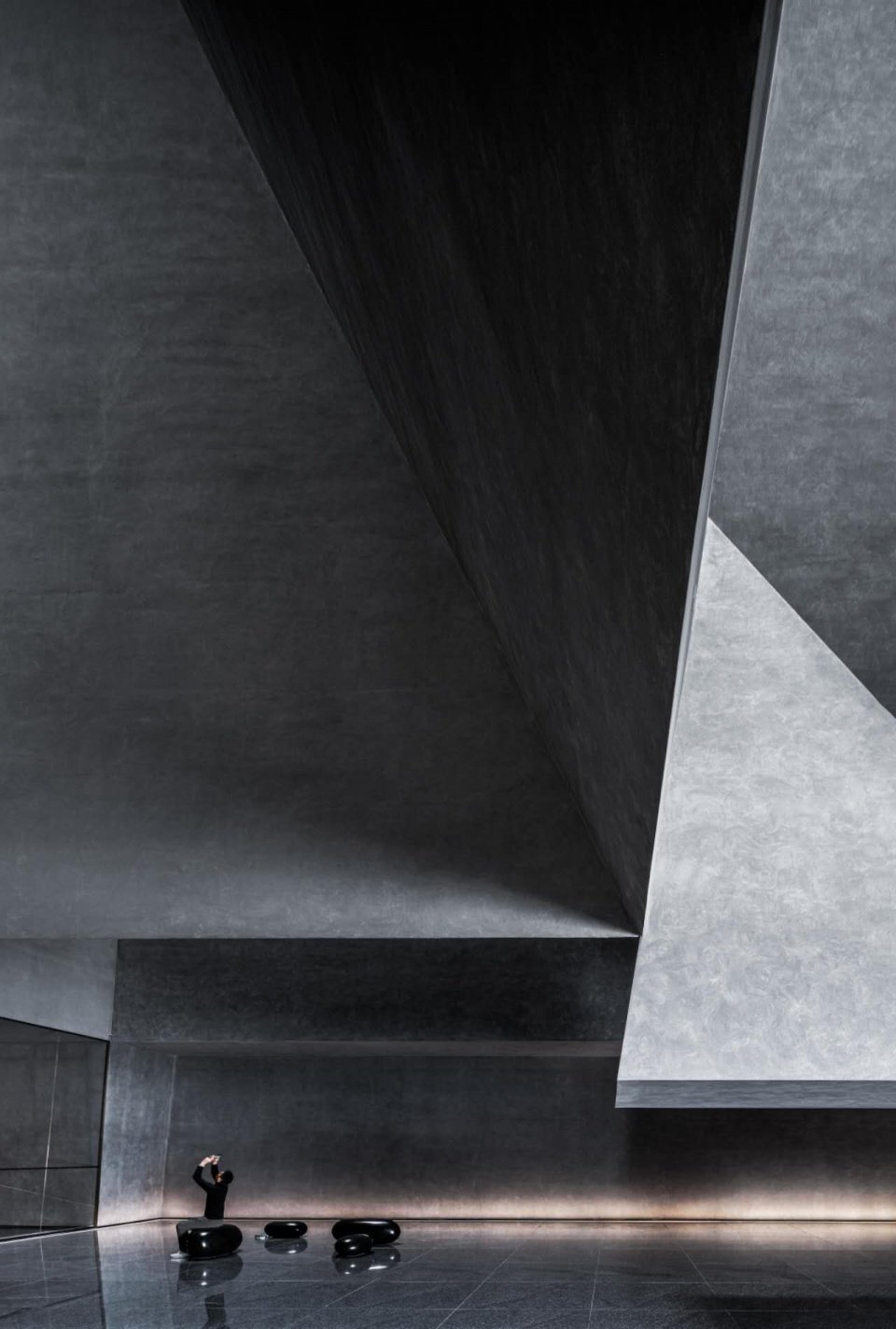
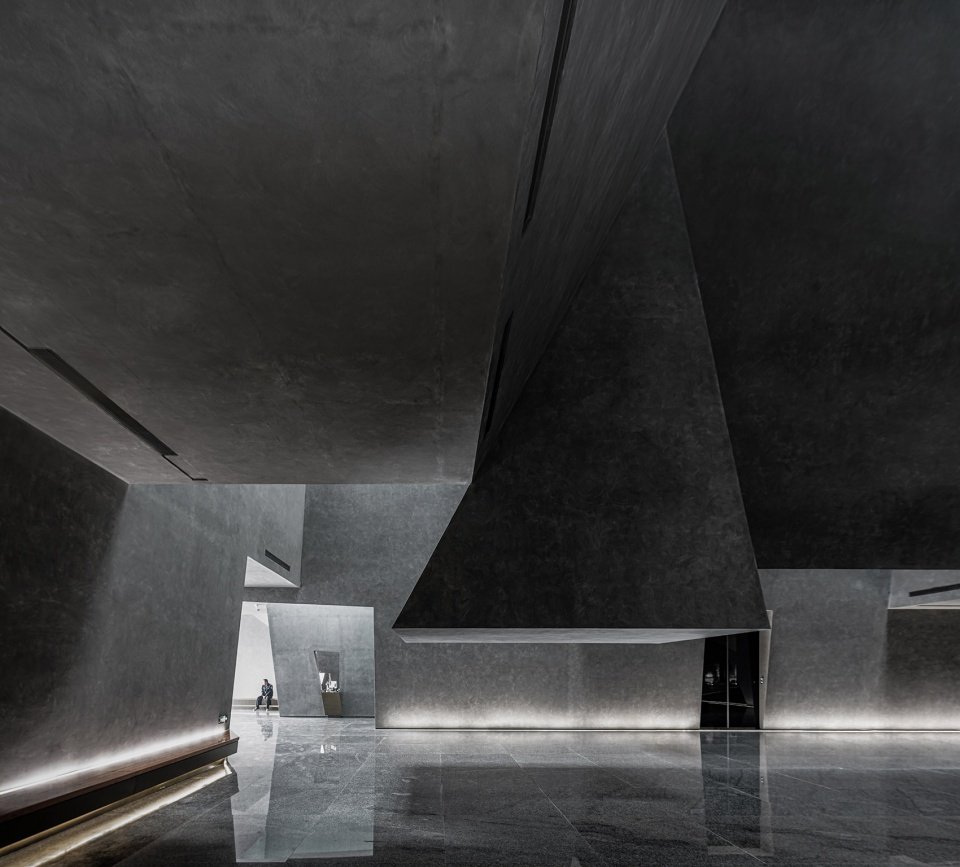
这个项目所容纳的是人们对化石和历史的研究态度,这些东西都很沉重,同时也是一个非常好的题材,所以我们希望能够把这种分量呈现出来,所以就产生了这样一种空间,它极具一种对重量的表达。有些人认为它传达的是一种黑暗力量,有些人则看到了Francis Bacon的那种挣扎的感觉,感受到人类想离开黑暗到达光明的那种力量。就像很多艺术家在视觉传达之后又产生新的二次创作,我们也在这个项目中找到了类似的东西,所以我们很开心能够拥有这样一次机会,把我们的思考凝固在那一刻。
卜骁骏:当你有足够的实践经验的时候,处理功能和形式之间的关系会非常轻松和游刃有余,因为建筑设计师就是干这个事的。当我们抓住一个新的语言的时候,它的前方是非常昏暗的,但我们会疯狂地发掘这种语言背后的崭新世界,这也是英良石材自然博物馆的一个特征。
当然这背后也是有大量的建筑教育和实践在支撑着我们,最后的呈现也确实达到了空间、题材以及创新性之间的融合。再加上它所容纳的展览物(恐龙化石和月球陨石等)跟它所营造的氛围达成了统一,导致它成为了一个大家还蛮喜欢的有力量的作品。它并不是一个资本的、昙花一现的东西,而是真的有科学研究人员在进行运作和维护。
When you have enough practical experience, it’s very easy to deal with the relationship between function and form, because that’s what architects do. When we grasp a new syntax, it is very dark in front of it, but we will frantically discover the new world behind the syntax, which is also a feature of the Yingliang Stone Museum.
Of course, there is also a lot of architectural education and practice behind it to support us, and the final presentation does achieve the integration of space, subject matter and innovation. Combined with the fact that its exhibits (dinosaur fossils, lunar meteorites, etc.) are in harmony with the atmosphere it creates, it becomes a powerful work that people enjoy. It’s not a capital, flash in the pan thing, it’s actually run and maintained by scientific researchers.
▼设计草图和模型,Design sketches and model
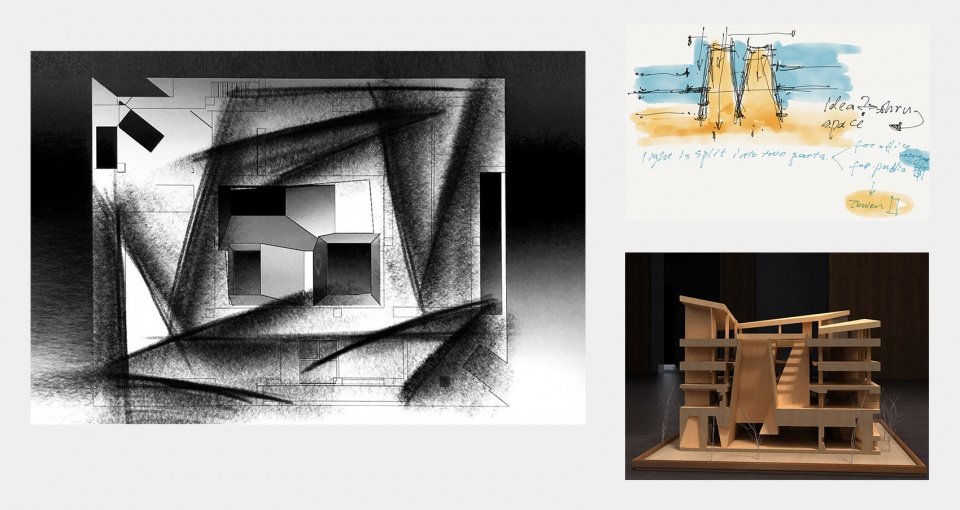
▼横向晶体穿插形成化石展厅,Horizontal crystalloids intersected, forming fossil showrooms
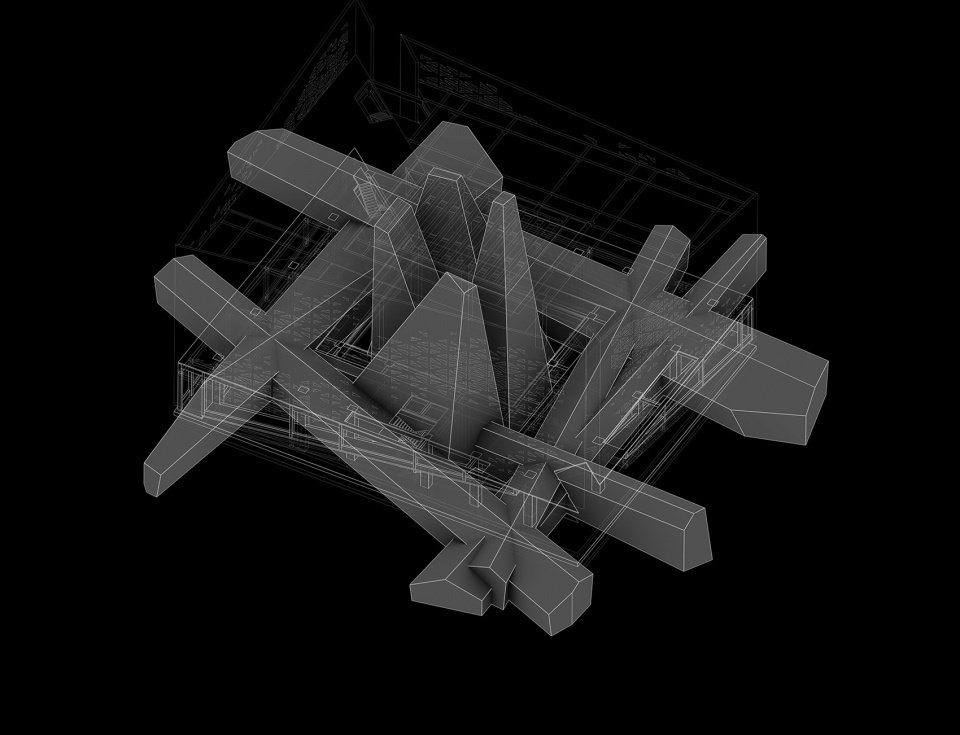
▼原始的石头晶体转译成的空间,正在与作为展品的远古化石进行着跨时空对话,The archaic stones crystallized into different architectural spaces while communicating with the spaces as the exhibits across time and spaces
“超现实主义”维度
Surrealism
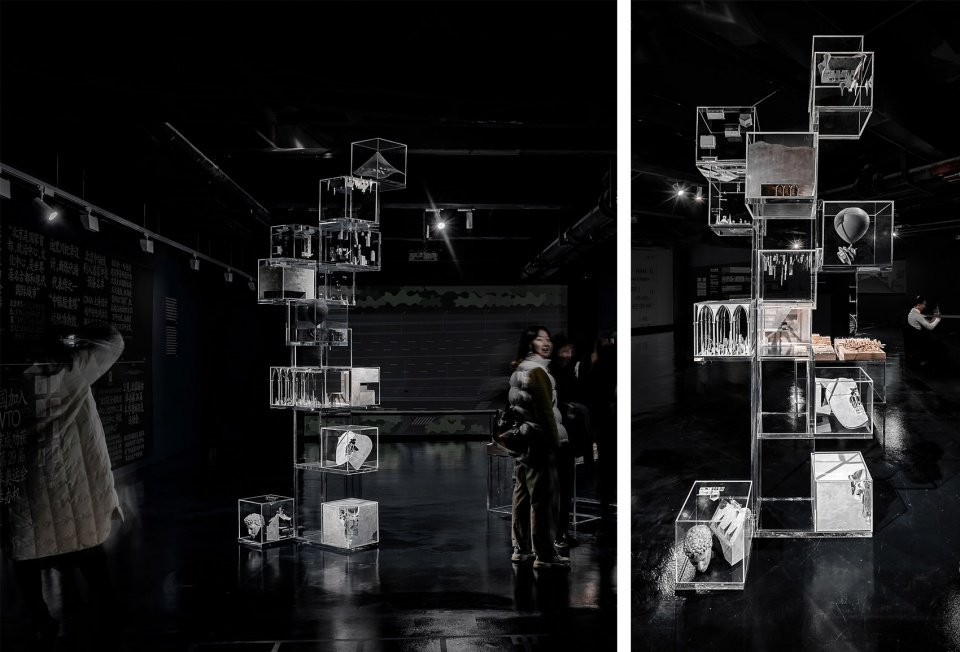
张继元:《停顿三秒的超现实主义都市》主要是在时间和空间上对Wittgenstein(维特根斯坦)的“真实性”的哲学思想的解读。建筑师或哲学家,或者任何一位人文主义者,都不单只是他所处行业中的一个表面性的角色,很多时候他是一个类似于detective的角色,他需要去重组现实和重新构造真实性。比如说我的面前摆有很多的事实,但是它背后的真相是什么?这就需要我们把这些事实拼凑起来、对建筑师来讲,每次面临一个城市问题或者建筑问题,会有很多基地上的现实呈现出来,比如说它的坡度,它的阳光等等,但它背后的现实是什么?这是我们想要探究的问题。
Zhang:‘Surreal Beijing in 3 Second Pauses’ is an primarily interpretation of Wittgenstein’s philosophical idea of ‘authenticity’ in time and space. Architects, philosophers, or any humanists are not just superficial roles in their respective industries. In many cases they work as “detectives” who need to reorganize reality and reconstruct authenticity. There are a lot of facts in front of me, but what is the truth behind it? This requires us to put these facts together. For architects, every time they face an urban problem or an architectural problem, there will be many realities on the site, such as its slope, its sunlight, etc., but what is the reality behind it? That’s the question we want to explore.
▼停顿三秒的超现实主义都市,2020年,Surreal City in 3 Second Pauses, 2020
点击这里查看更多,Click HERE for details
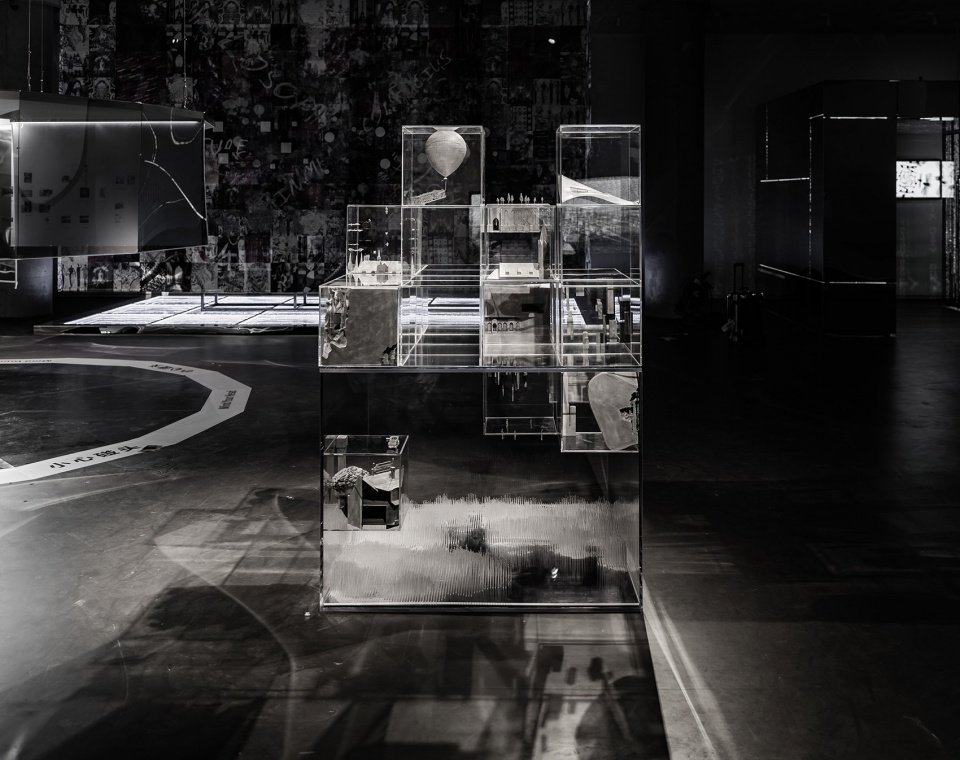
▼停顿三秒的超现实主义北京,2023年,Surreal Beijing in 3 Second Pauses, 2023
点击这里查看更多,Click HERE for details
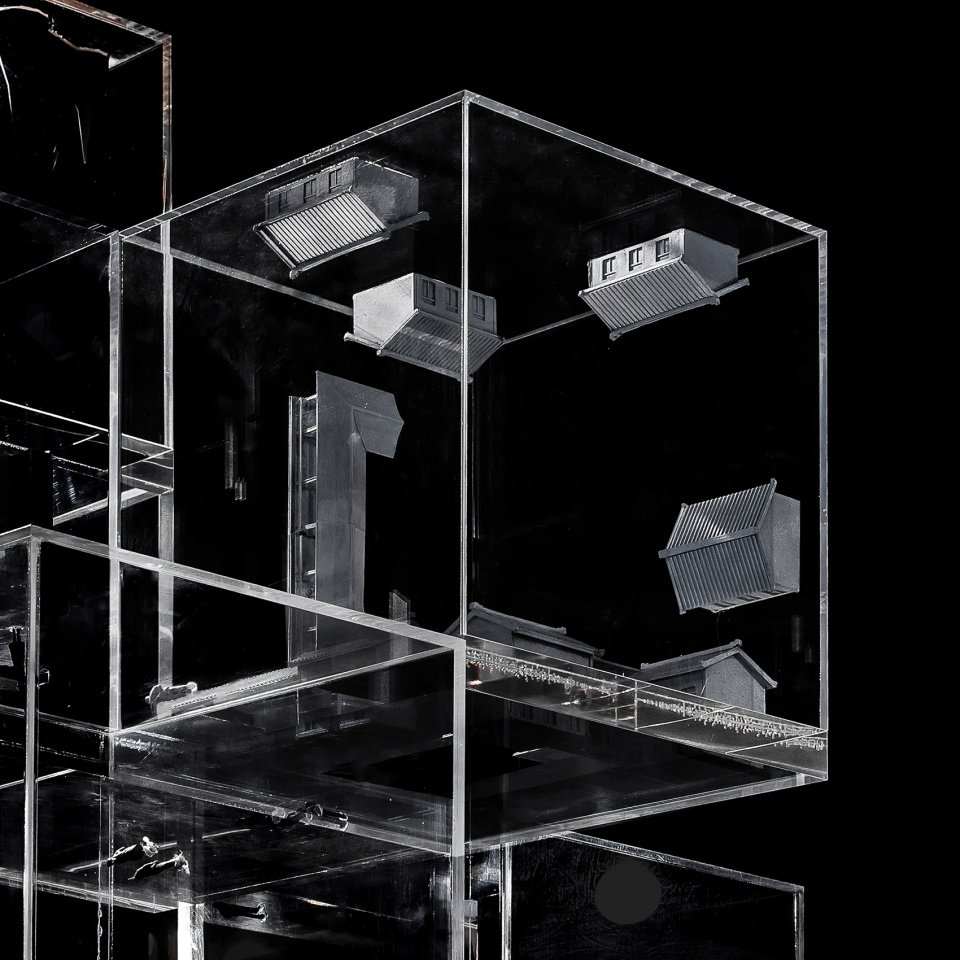
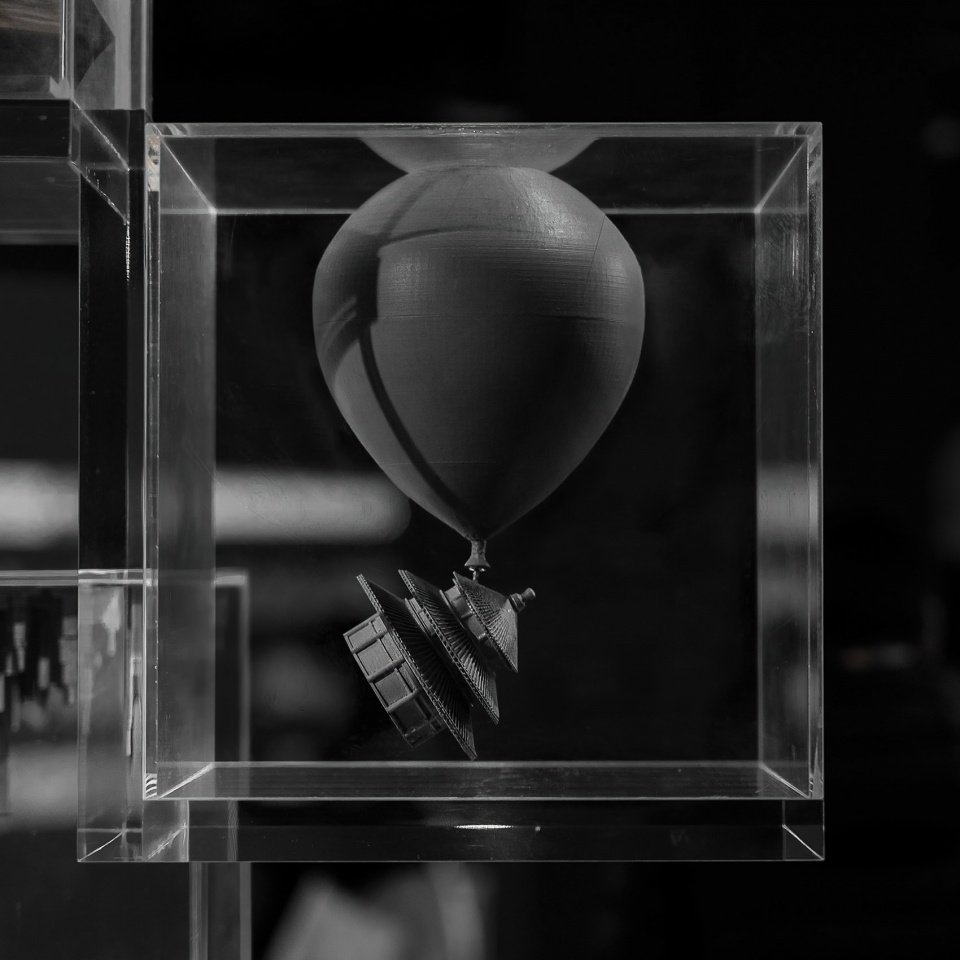
张继元:这是一个实验性的作品,我们在玩一个游戏,我们想象的是用不同的建筑的元素去重构我们的都市,然后在这个过程中颠覆性地去改变建筑的空间关系、人与建筑元素的空间关系,以及人与这个城市的空间关系。所以你会看到我们把一个大的气球跟天坛联系在一起,它们是尺度不同的东西,一个是object,另一个是名胜古迹,然后后者还被“挑”起来了,展现了一种反重力的思考。
Zhang: This is an experimental work. We are playing a game. What we imagine is to reconstruct our city with different architectural elements, and in this process, to subversively change the spatial relationship between buildings, between people and architectural elements, and between people and the city. So you’ll see that we associate a big balloon with the Temple of Heaven, they’re different scales, one is an object, the other is a place of interest, and then the latter is “picked up” to show a kind of anti-gravity thinking.
▼时境通过一系列假设的建筑时刻,尝试如何在北京的城市环境中处理空间的悖论,The design tests how to deal with the paradox of space in the urban context of Beijing by creating a series of hypothetical architectural moments
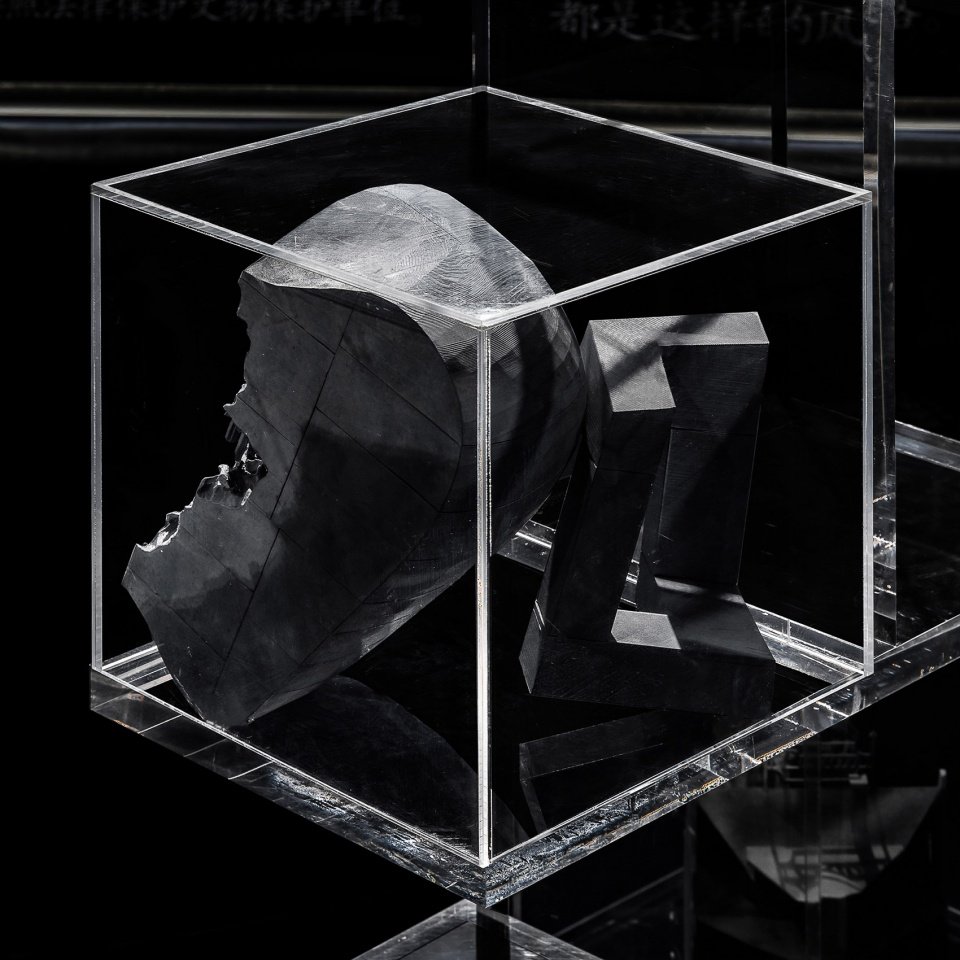
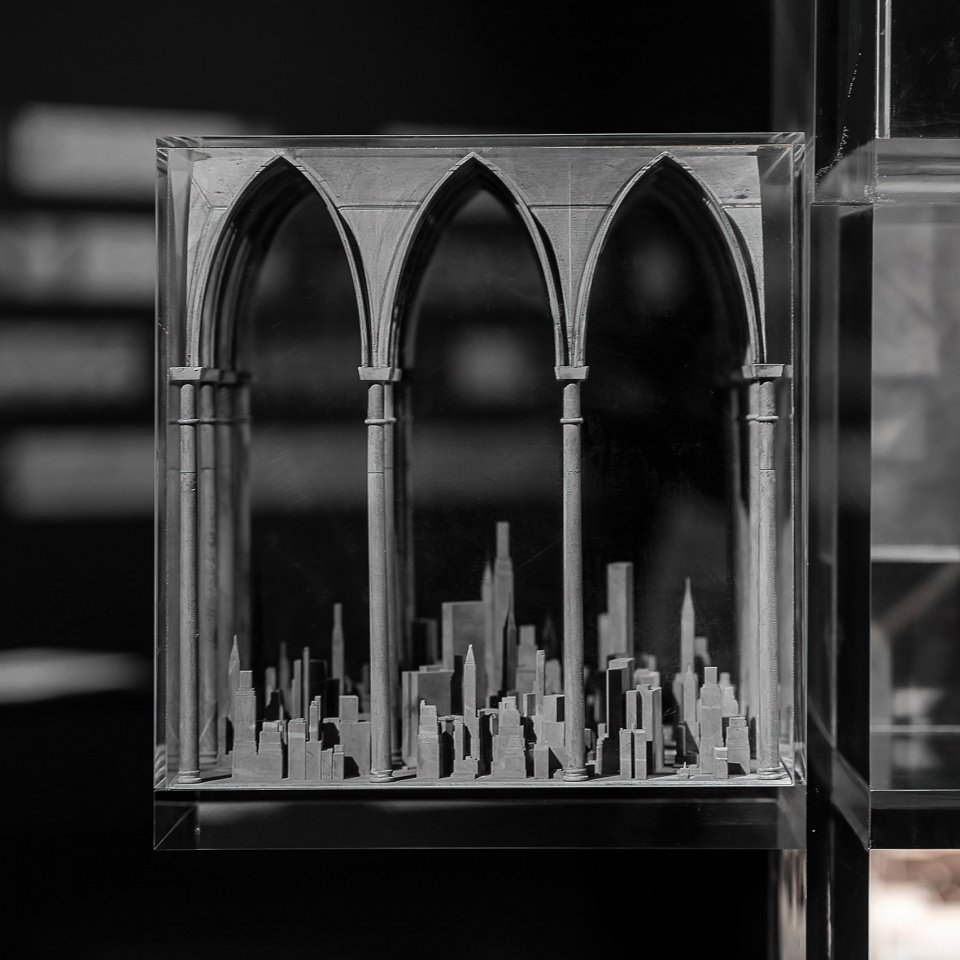
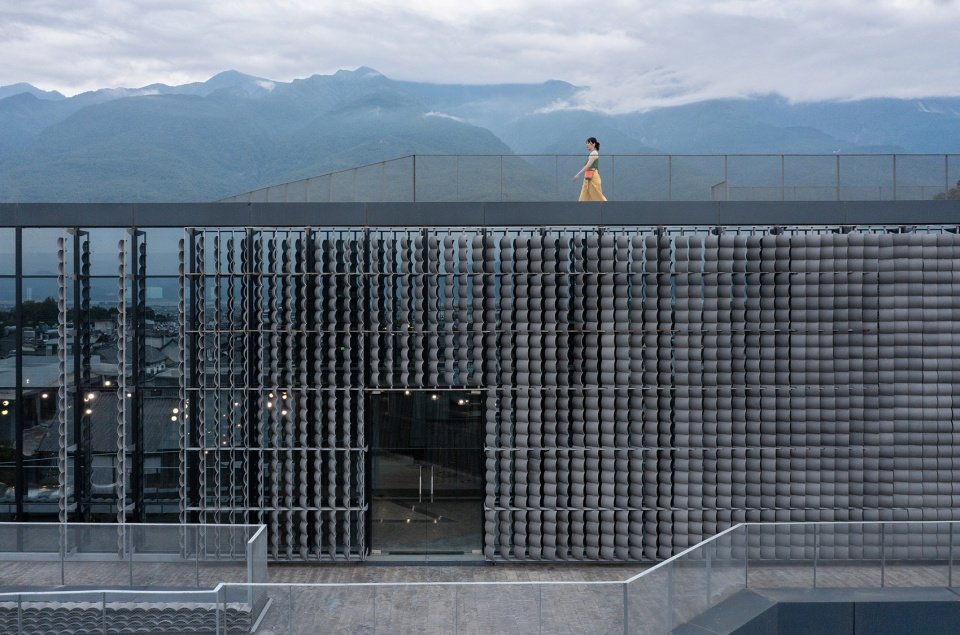
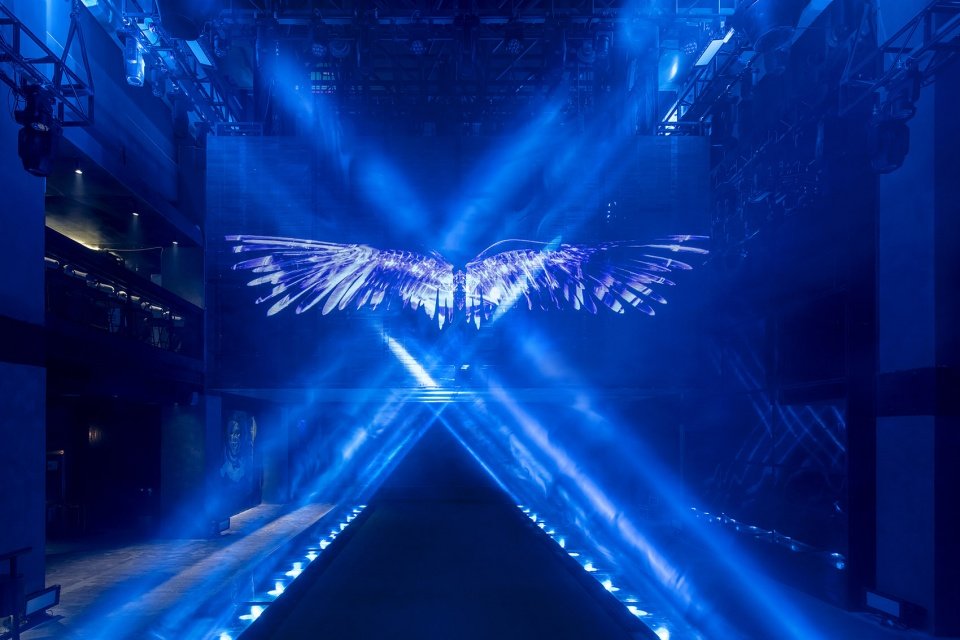
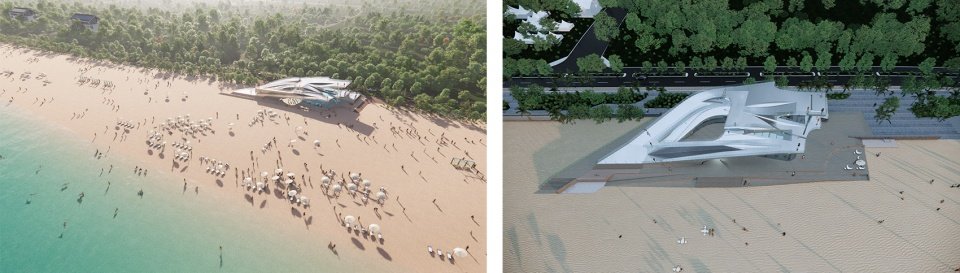
张继元:我们想以任何一种方式去打破人们对城市的固有想象,假设所有人认定的命题都不成立,我们会得到一个怎样的城市?我们所探讨的是一个关于城市与建筑的悖论,所有存在的东西都被假设走在相反的方向上,在这个过程中我们发现了一定的城市的现实。这些非常超现实中的现实空间是存在的,并且是一种瞬间的而非物理上的存在性。我们觉得这样的瞬间要比我们习以为常的瞬间来得更为真实,因为它揭示的是多维度的、人们欲望之下的一种真实。我们在大理的变压剧场,以及蔚蓝海岸的沙滩驿站,这两个项目也都是从超现实主义的角度去探索空间、时间和人的关系,以及如何在超现实主义的维度上去重构空间。
Zhang: We want to disrupt people’s preconceptions of the city in any possible ways, assuming that the proposition that everyone assumes is not true, what kind of city will we get? What we are exploring is a paradox about cities and architecture, where everything that exists is assumed to go in opposite directions, and in the process we discover a certain urban reality. These very surreal spaces of reality exist, and are instantaneous rather than physical. We feel that such moments are more real than the ones we take for granted, because they reveal a multidimensional reality beneath our desires. Many of our projects, including Dali Transformer Factory Theater and the Beach Pavilion of Seatopia, also try to explore the relationship between space, time, and people from a surrealist perspective and how to reconstruct space in the dimension of surrealism.
▼大理变压剧场,Dali Transformer Factory Theater
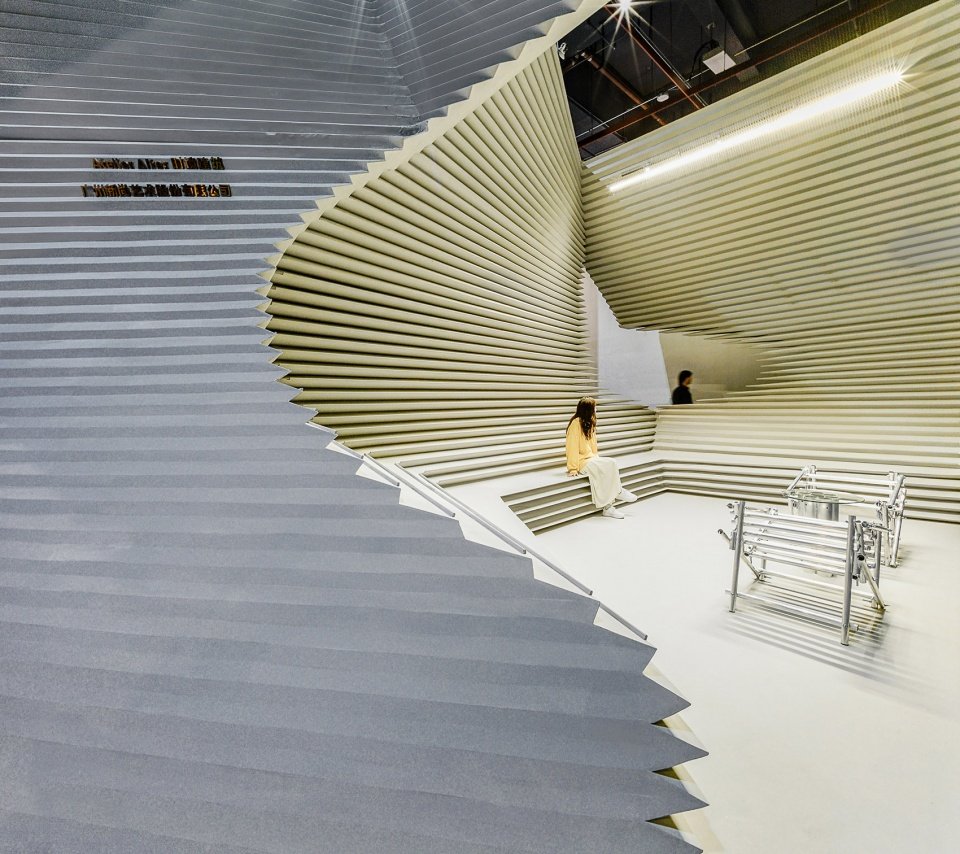
▼可再利用的展亭,Duo-purposed Exhibition Pavilion
点击这里查看更多,Click HERE for details
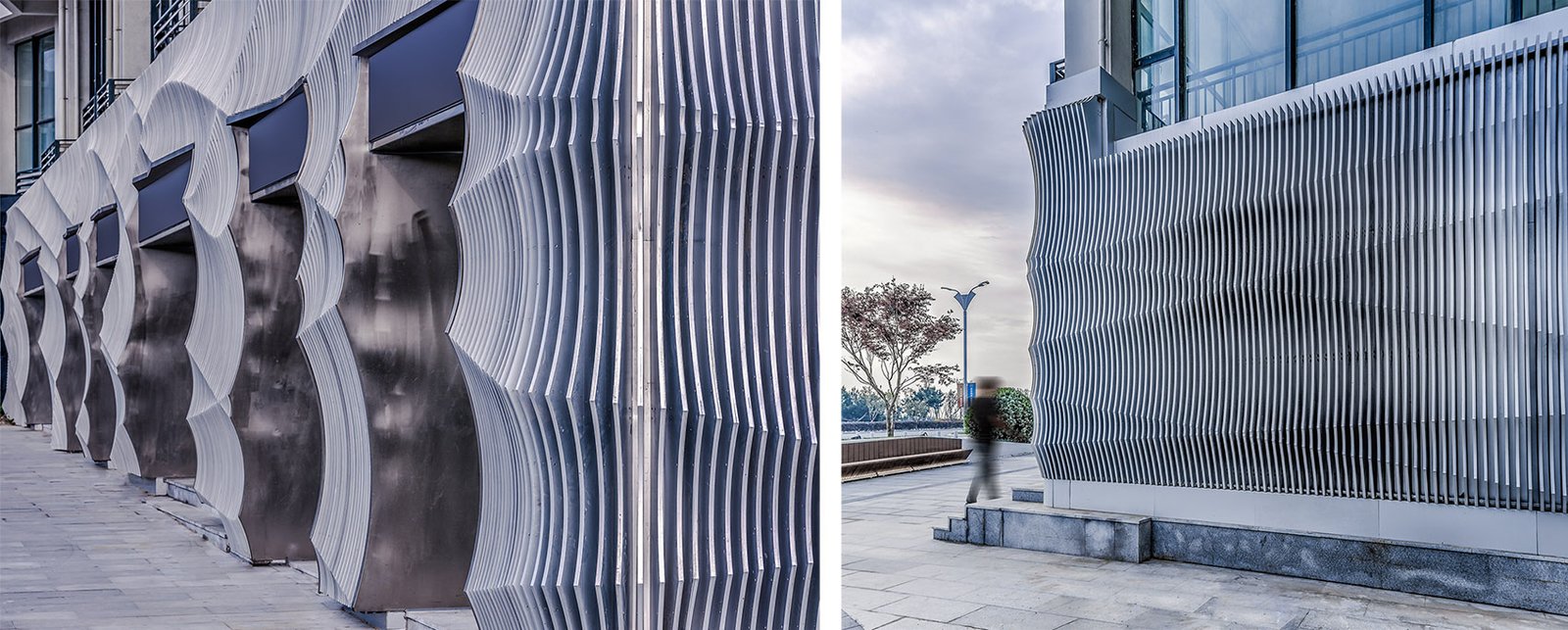
▼垂直的潮汐– 青岛东方时尚中心商业立面改造,The Vertical Tides – Reconstruction of the facade of a main commercial building in Qingdao
点击这里查看更多,Click HERE for details
________________
保持昂扬向前的“中国性”
Maintaining “Chineseness” withambition
卜骁骏:其实没有哪个建筑师的成功是完全依托于对本土文化或某一个时间领域的限制,他们都是立足于创新的。当他的创新足够有强度的时候,他自然会打下他那个时代和他所处的民族或者语言的烙印。比方说西扎,或者越南建筑师武重义。你会发现这些研究和工作是永恒的,它是关于时间的。所以我们这样一个事务所的力量在于,要在这个时代写下我们的能量,写下我们的创作创新,不要重复过去,这是很重要的。我们不需要回答到底什么是中国性或者本土性,因为当你的声音足够强的时候,你所做的东西也就变成了当地的一部分。我们有自己的特色,我们中国的国力是有资本去建立我们自己的建筑形象的。在我们看来,只要你是基于事实、基于你的深刻思考而出发的,这本身就已经很“中国”了。
Bu: In fact, no successful architect relies entirely on an exclusive culture or a particular time period. They succeed because they are innovative. Siza, for example, or Vietnamese architect U Trong Ngai. You find that the research and the work is timeless. It’s about time. So the strength of an office like ours is very important to show the energy of creativity in this era, to create innovatively, and not to repeat the past.We don’t need to answer the question of what is “Chineseness” or what is local identity, because when you speak out loud enough for yourself, what you do becomes part of the local. We have our own characteristics, our Chinese national strength is the capital to establish our own architectural image. In our opinion, the act that you start what you do with facts and deliberation, that in itself is already a proof of ‘Chineseness’.
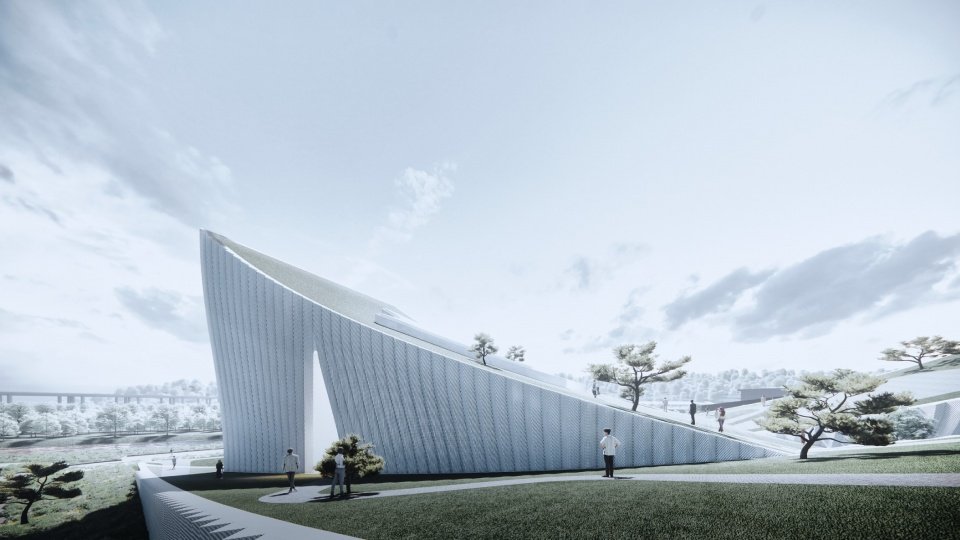
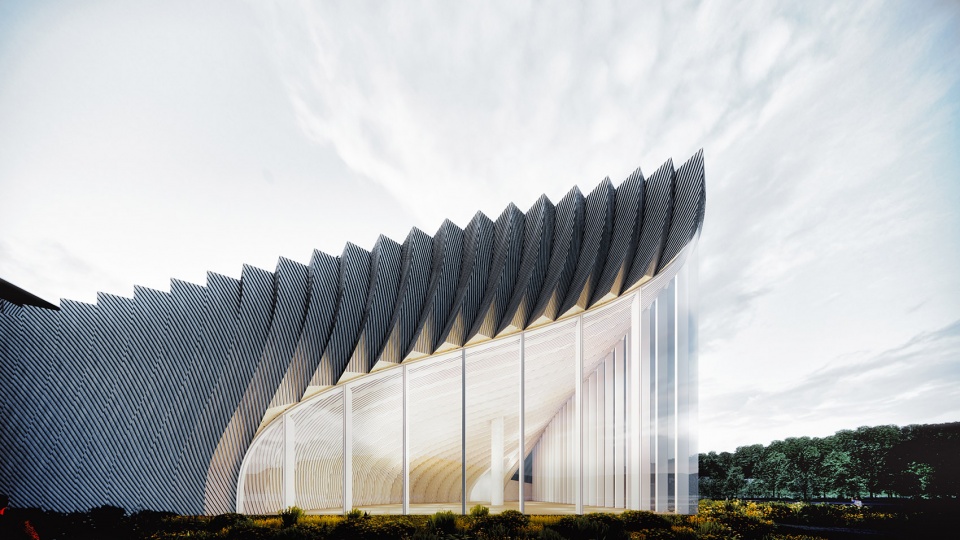
▼新圣农博物馆(在建),Sunner Museum (under construction)
▼沙滩驿站,Beach Pavilion of Seatopia
卜骁骏:中国的建筑师,应该更加地ambitious,更加拥有动机、冲动,以及开放的信念。在这个时代,我们的命运已经跟“中国性”紧紧地联系在一起了,这是一个政治话题,也是一个经济话题,但同时它也蕴含在我们所有中国建筑师的血液里。你所处的国家拥有巨量的工业体系,拥有这样前进的机会,所以中国建筑师的“中国性”应该是更昂扬和向前的。我们没有必要为了政治而去迎合别人眼中的中国建筑师的印象。我们所关注的应当是对建筑本体的思考,建筑应该是什么?建造最基本的东西是什么?年轻人如果意识到这一点的话,才可能有更多创作的可能性。
Bu: Chinese architects should be more ambitious, have more motivation, impulse, and open-minded. In this era, our destiny is tightly linked with “Chineseness”. China has a massive industrial system and opportunities for moving ahead. There is no need to cater to the images of Chinese architects in other people’s mind for the sake of politics or for any other reasons. The only thing we need to focus on and thinking about is the essence of architecture. What should architecture be? What are the fundamental things to architecture, and to construction? The youngsters also need to be aware of these questions, otherwise they can’t have the possibilities to produce any creative works.
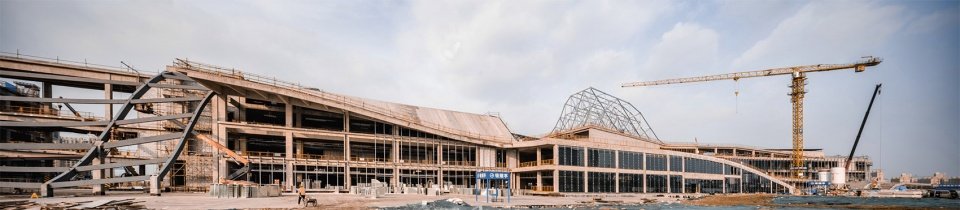
▼中法武汉生态示范城文体中心(在建),Sino-French Wuhan Ecological Demonstration City Culture and Sports Center (under construction)
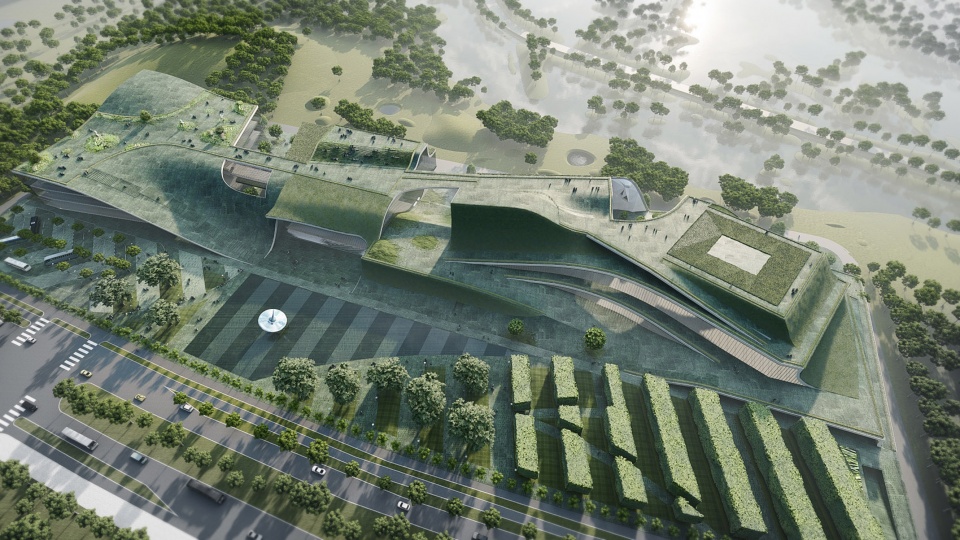
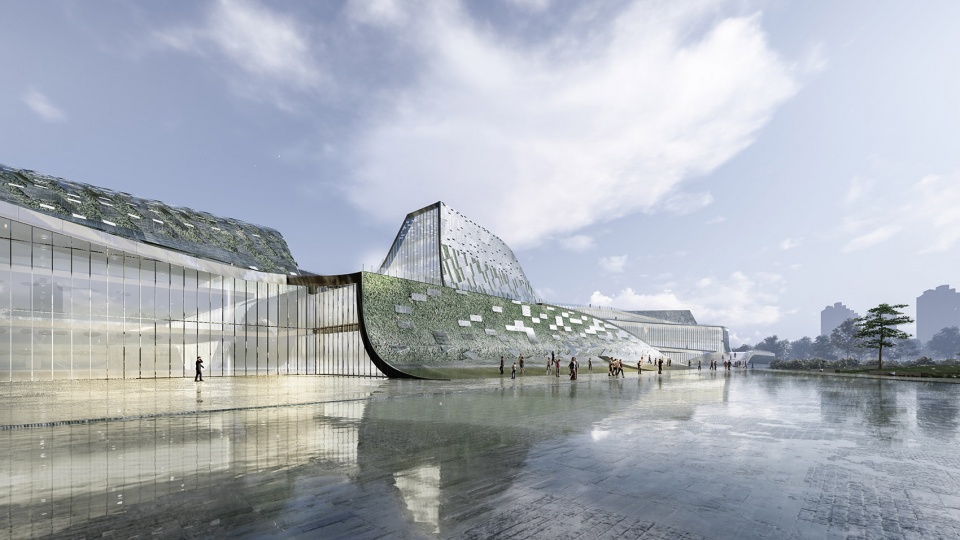
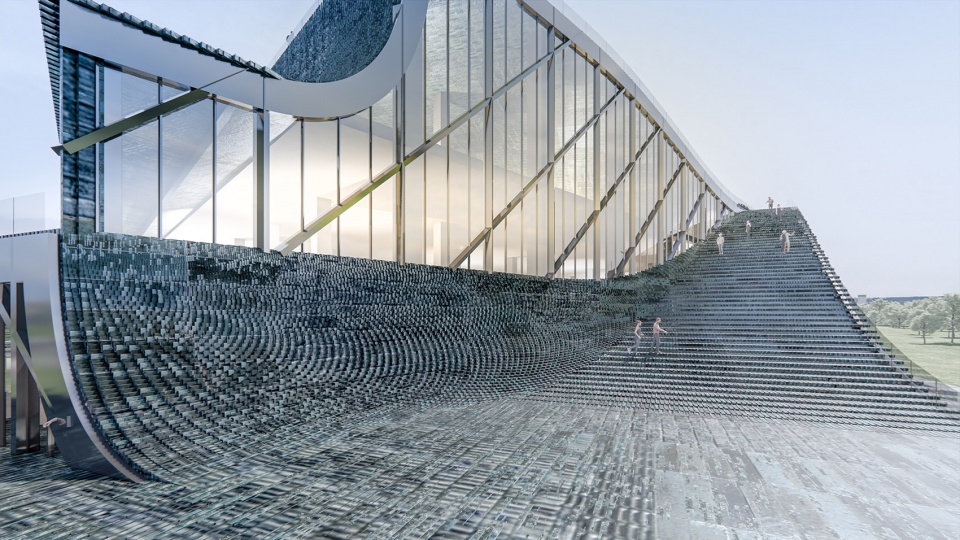
▼施工面貌,Construction phase
卜骁骏:我们也非常希望能够把目前的思考和能量带给青年的朋友们。在b站上我们开设了自己的视频号,一方面展示我们的作品,另一方面也提供了我们的课程和访谈。我们目前还在清华大学和天津大学同期教授两个studio。在清华我们开展了一个多文化交融场所的研究,在天大我们进行的是关于韩国大邱的衰落工业城市的拯救计划,是由来自全球7个地区的studio的联合教学。今年9月份我们还会在韩国有一个汇报和展览。
张继元:我们现在正在做两个超高层项目,另外还有文化中心、体育馆、社区中心以及三个博物馆项目。越来越多的文化项目正在向我们聚拢,每一次我们都非常真诚地面对我们的作品和场地,然后不停地与场地进行对话。因为我们保持着小型的工作室的模式,所以在这种非常的克制的环境下工作,即使是在压力很大的情况下,也可以很平静地去面对一个项目。
Bu: We also hope that we can bring the current thinking and energy to our young friends. We set up our own video account on bilibili, showing our works and providing our courses and interviews. We are currently teaching two studios simultaneously in Tsinghua University and Tianjin University. At Tsinghua University, we carried out a study on a place of multicultural integration. At Tianjin University, we carried out a rescue plan on the declining industrial city of Daegu, Korea, which was co-taught by studios from seven regions around the world. We will also have a presentation and exhibition in Korea in September this year.
Zhang: We are currently working on two high-rise projects, as well as a cultural center, gymnasium, community center and three museum projects. More and more cultural projects are coming to us, and each time we are very sincere about our work and the site, and then keep talking to the site. Because we maintain a mode of small studio, we work in this very restrained environment, even under a lot of pressure, and can be very calm to face a project.
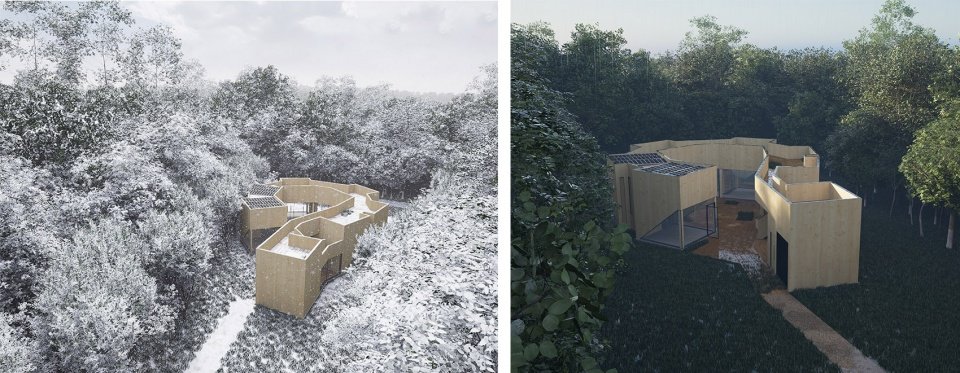
▼德国湖畔住宅项目,与Christoph Hesse Architects合作设计(在建),Residential project in Germany, in collaboration with Christoph Hesse Architects (under construction)
张继元:我对这个行业的总体感受还是非常乐观的,因为越是往“线上”和“元宇宙”这些方向走,越需要建筑师给出独立的、综合性的判断。这是AI需要很长的时间才能做到,甚至是永远无法做到的。成为建筑师是一个独立的思维的训练的过程,即使未来不再做建筑师,它其实也是一个很好的思想方法。所以我们希望可以越来越往理论性的方向走,希望我们的理论和实践能够并行,然后在这个理论中开发出更多的建筑的语言,最终让这个语言通过我们的实践作品逐渐落地。
Zhang:I still feel very optimistic about the industry in general. In the process of people moving toward the era of “cyber” and “meta-universe”, the need for architects to give independent, comprehensive judgements is even greater. This is something that AI will take a long time to achieve, if ever. Becoming an architect is a process of training independent thinking, which is also a good way of thinking even if we no longer do architecture in the future. We tend to move further in a theoretical direction, with the hope of making our theory in parallel our practice, by which new architectural languages can be developed and will eventually come to life through our physical works.
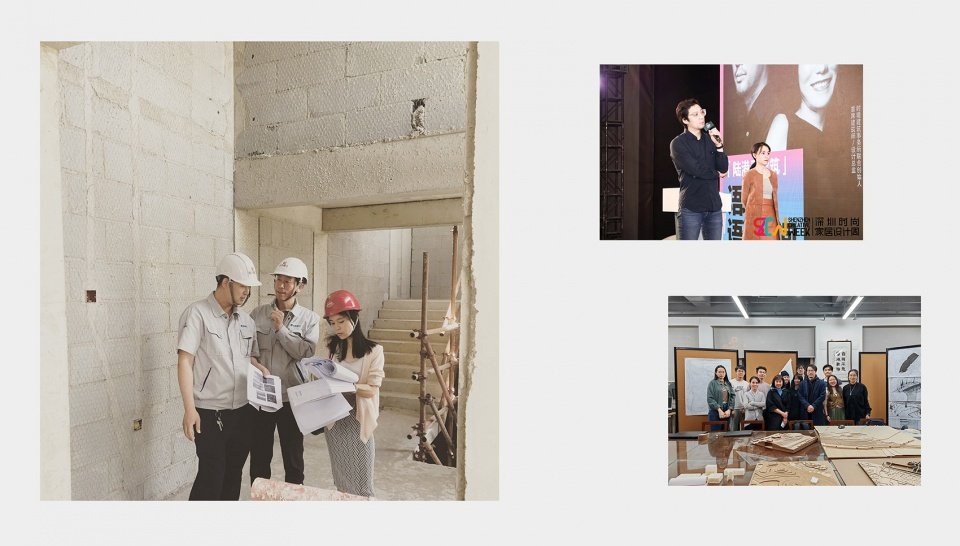
▼左:张继元在工地现场;右上:讲座;右下:2023年,张继元和卜骁骏在清华评图。Left: Zhang at the construction site; Top right: Zhang and Bu giving a speaking at Shenzhen Design Week; Bottom right: The duo as tutors in the final review at Tsinghua University
_________________
要么躺平,要么就迎难而上
Go for the race, or just quit
卜骁骏:建筑师是一个资源型的职业,随着你的年龄增长和作品的积累,你的资源是一个滚雪球的状态,它是呈指数级而不是线性地变化的。建筑最残酷的一点就是,每个年龄段的建筑师都会被放在一个平台里进行比较,可能你要在最没有钱、最没有时间和资源的时候去跟这些拥有海量资源的大咖同台竞技,年轻人可能会觉得这是一个非常厮杀的行业,这是没有办法的事情,这个行业你要么就躺平,要么就迎难而上。
很多人会说建筑行业在下行,但在我们看来,其实(在衰退中)资源正在逐渐向更加有原创精神的公司倾斜。有些业主在老中青建筑师同台竞争的情况下依然会选择我们,会认可一种精神面貌。他们为什么这么做?因为他们不希望把自己的城市建设成另外一个国际大都会,他们不希望使自己的场馆变成市面上随处可见的普通的建筑,他们希望把项目交给一个能够阐释出其背后文化的设计团队。我们已经来到了一个对文化有着强烈诉求和关注的时代,那种只靠雕塑式的、英雄主义的建筑就可以挽救行业的时代已经过去了,它需要与人文之间发生一种更深刻的关系。
张继元:在达到一定的实践年限之后,我们现在对之前不确定的东西会表现得更淡定和更有把握,并且更明确自己的方向,知道应该从哪个角度去深入挖掘我们自己的建筑语言。这几年我们觉得自己好像已经不太需要去和别人比较了,因为建筑它不是一种时尚,不是说过几年你就过时了。建筑是一个相对永恒的概念,我们希望的是创造属于自己的经典与永恒。保持竞争力,就是要保持自己的独特性,越是在纷乱复杂的环境中越能够保持清醒,这也许就是我们最核心的竞争力。
对每一个真正做到独立实践的人来说,建筑是一种理念和信仰。我们跟建筑是共同呼吸的关系,建筑既是我们的生活,也是我们的思考。我的两个孩子有时候会从他们的角度对我发出一些问题,比如说,“妈妈,你觉得这个空间想表达什么?”我觉得当你的梦想足够真切的时候,它是能够感动所有人,能够超越年龄、层次和各种先入为主的观念。
Bu: Being an architect is a resource-based profession, and as you grow older and accumulate your work, your resources are in a “snowballing” state that changes exponentially rather than linearly. The cruelest thing about architecture is that architects of every age will be put on a platform for comparison. Maybe you have to compete with those who have a lot of resources when you have the least money, the least time and the least resources. Young people may think that this is a very competitive industry. You can only go for the race, or just quit.
It’s saying that the industry is declining, but in our view there is a gradual shift in resources towards more original companies. Some owners in the old and young architects on the same stage of competition will still choose us, will recognize a spiritual outlook. Why did they do that? Because they didn’t want to turn their city into another global metropolis, they didn’t want their venue to become an usual architecture that you see everywhere, they wanted to turn the project over to a design team that could explain the culture behind it. We have entered an era where there is a strong demand and concern for culture. It is no longer the time when sculpture-like, heroic architecture alone can prop up the whole industry. it needs a more profound relationship with humanity.
Zhang:After reaching a certain amount of practice experience, we become more equanimous and confident about the things that were uncertain before, and more convinced of our direction, knowing from which angle we should dig deeper into our architectural language. In the past few years, we feel that we no longer need to compare ourselves with others, because architecture is not like fashion, which means you don’t need to worry about whether you are going to be outdated in a few years. Architecture is relatively timeless, and it is our vision and mission to create our own classics and eternity. To maintain competitiveness is to maintain our uniqueness, and for Atelier Alter Architects, I think its core competence lies in our ability to remain clear-minded in this increasingly chaotic and complex environment.
Architecture is an idea and a belief for everyone who truly practices it independently. We breathe with architecture. Architecture is not only our life, but also our thinking. My two kids sometimes ask me questions from their point of view, like, “Mom, what do you think this space is saying?” I think when your dream is real enough, it can touch everyone, transcends age, level and preconceived notions.
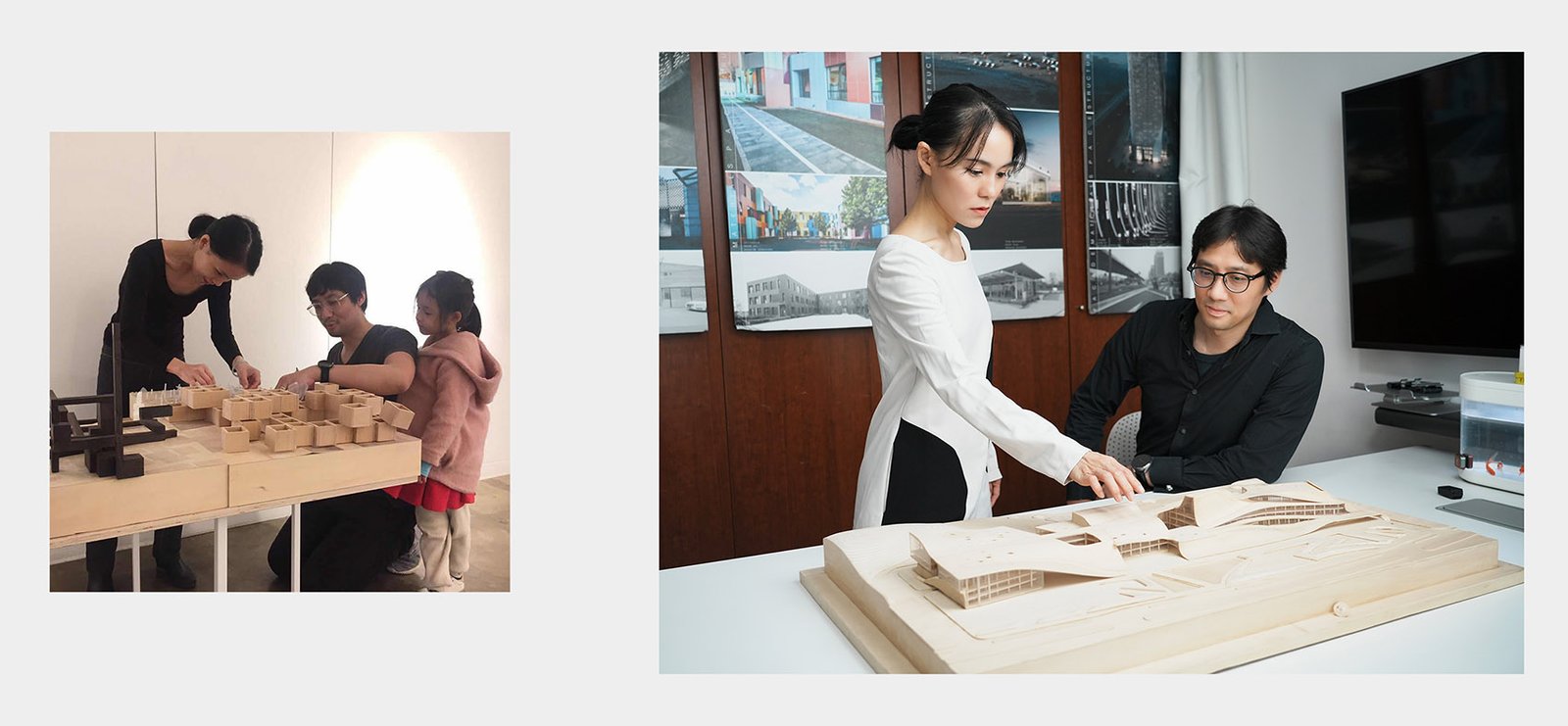
▼张继元和卜骁骏在一起工作,Zhang and Bu are working together
More:时境建筑。更多关于他们:Atelier Alter Architects on gooood