
来自ASLA对gooood的分享。
VanPlay: Parks and Recreation Vision Plan |Design Workshop, Inc.
项目概述
PROJECT STATEMENT
“在解决公平性问题方面,VanPlay计划认识到了部分人群在公园和休闲空间上享有的特权,并致力于为那些没有特权的人群提供额外的支持和欢迎。”
温哥华的63.1万居民使用着191种语言,展现出显著的多样性。这种多样性同时也反映在该市1300公顷的公园、28公里的海堤以及由175个休闲设施所构成的网络当中。这些场地为市民提供了万花筒般的丰富体验,但在对其进行详细分析时,许多与公平性和可达性相关的问题便显露出来,其中受影响最明显的是温哥华的12万低收入人群。
在景观设计师的带领下,一个多学科的团队对温哥华全市的公园和休闲场地实施了25年来的首次研究,并为之制定了一个以数据为导向的计划,使社区的公平性、资产更新以及联通性成为城市决策的核心。基于3万多次社区对话,这项获得参与者一致通过的计划已获得2.65亿美元的资金,将为更广泛的人群提供与自然接触的机会,同时撼动固有的权力杠杆,为降低空间公平性的系统性障碍提供解决方案。
“In addressing spatial equity, VanPlay recognizes the inherent privilege some populations have to enjoy parks and recreation and provides added support and welcome to populations without that privilege.”
Vancouver embodies diversity in the 191 languages spoken by the city’s 631,000 residents. This diversity is reflected in the kaleidoscope of experiences available throughout 1,300 hectares of parkland, 28 kilometers of seawall, and network of 175 recreation facilities. However, when analyzed these exceptional opportunities to recreate are fraught with systemic barriers and vulnerabilities to equity, most notably for the 120,000 Vancouverites who experience poverty.
Undertaking the first citywide parks and recreation study in 25 years, the landscape architect led a multi-disciplinary team to craft a data-driven plan that puts community priorities of equity, asset renewal, and connectivity at the core of the city’s decision-making. Informed by over 30,000 community conversations, the unanimously-adopted plan has already garnered $265 million in new capital expenditures to provide more people the opportunity to connect to nature and shift the levers of power to bridge systemic barriers to spatial justice in Vancouver.

▲场地平面图:温哥华拥有1300公顷的公园用地,28公里长的海堤以及由175个休闲设施构成的网络。这些公共空间为市民带来了丰富多彩的体验。VanPlay是针对温哥华的公园和休闲设施而提出的愿景。SITE PLAN. Vancouver offers a kaleidoscope of experiences available throughout 1,300 hectares of parkland, 28 kilometers of seawall and network of 175 recreation facilities. VanPlay is the vision for parks and recreation equity in Vancouver. ©Design Workshop Inc.
项目说明
PROJECT NARRATIVE
项目目标
VanPlay的核心内容是三个Bold Moves(大胆行动),其目的是支持建立公平性和连通性,并为现有人口和未来(预计到2040年)将会增加的12.5万名城市居民提供公园和休闲空间。作为一个44平方英里(28160英亩)的内陆城市,温哥华需要增建一个与史丹利公园(1001英亩)同样大的新公园,以达到预期的绿化密度。为了帮助解决这一未来问题,同时改善历史上的不平等地区,“Bold Moves”将引入三种创新性的规划工具:
1.倡议区映射工具(Initiative Zone Mapping Tool)能够突出城市中需要资源的区域,并且包含公平性的分析要素,使项目、功能分区和规划可以集中在一起,随着时间的推移提供更加公平的服务。
2.公园和休闲用地目标工具(Parks and Recreation Asset Target Tool)能够考虑到公园、自然区域和休闲设施的数量、质量、容量以及分布,同时兼顾人口增长、维修延迟和资源受限的问题。
3. 全市公园和休闲用地网络工具(Citywide Parks and Recreation Network Tool)构建了一个长达100年的无缝式公共领域愿景,将社区中心、步道系统和大型公园等场所与对公众开放的海滨用地连接起来,从而扩大区域内的使用范围,并为受到气候变化影响的生态系统提供保护。
社会数据和简要分析
以上提到的每个工具都解决了一个关于公园和休闲用地的未来的关键性问题,它们以先前提出的规划,以及针对温哥华的社会人口所作的研究为基础。项目团队对全球具有代表性的、能够体现公平性的公园和休闲设施进行了案例分析,并通过一项持续6个星期的全系统观察研究(SOPARC,即社区中的游玩和休闲用地观察系统),记录了不同收入和不同背景的社区的1.8万多位居民对于公园的使用情况。
利用这些发现,加上近期关于公园供给的研究,项目团队考虑到了一系列通常为人们所忽略的通道障碍,例如繁忙的街道交汇口、公共交通的缺乏,以及当地休闲设施的高昂定价。
如何衡量和反映空间的公平性?
99%的温哥华居民生活在步行10分钟就能到达绿地的区域范围内,但这些绿地的质量和状况存在很大的差别,尤其是在低收入的社区。倡议区映射工具通过使用三个指标(以街区为单位相互叠加),揭示了城市中被边缘化的区域:它们长期缺乏公园空间、休闲机会以及绿化充足的生活环境。这种不平等性反映了系统性的偏见,对健康和福祉、社会资产以及经济发展都产生了深刻的影响。
VanPlay所引入的空间公平工具十分强大,它能够简洁而又清晰地显示出优先区域的位置。城市中缺乏公园用地、绿化程度低且很少享有休闲机会的地区,往往都是那些小型公寓的集中区。这里的居民没有像后花园那样的户外空间,使他们可以长时间地在家隔离;而在炎热的夏季,也没有可以乘凉和消暑的空间。
如何在满足社区需求的同时公平地分配有限的资源?
北美的城市发展正在努力地跟上社区的需求。以丹佛为例,按照现有的资金水平,该城市需要400多年才能补完所有缺失的人行道。各种复杂且长期存在的问题(如开发和投资模式等)往往会导致整个城市陷入设施分布不均的状况。
公园和休闲用地目标工具评估了该市的休闲娱乐资源(资产),其中包括公园空间、运动场、溜冰场和城市森林等等。该工具不仅分析了这些资源的位置,还分析了它们的环境状况和更新的时间表,并通过目标设定对未来的需求进行了考量,以确保所有温哥华人都能享受到优质的设施。规划团队还全面参考了具有基准性的方法,包括公共土地信托基金会的ParkScore公园评分系统,以及整体资产管理的最佳实践。在此基础上配合使用倡议区映射工具之后,城市如今可以借助三变量测量法得知哪些设施需要进行布局和质量上的改进,以及哪些设施坐落于长期遭受不平等的地区。
如何将更多的人与自然联系起来,同时加强环境的复原能力?
全市公园和休闲用地网络工具将可供游玩、锻炼和社交的场所概念化,为所有年龄和行动能力的步行和骑行者提供了穿梭于这些休闲空间的直观连接,同时也为城市的野生生物和雨水的流动塑造了路径。多个部门之间的合作有助于了解该工具如何帮助温哥华适应气候变化的影响(例如海平面上升可能导致11%的城市陆地面积损失),以及如何在城市中增加更多休闲和改善健康的机会。
由于温哥华的土地价格每公顷高达数千万加元,因此几乎不可能通过购买新公园所需的土地来平衡人口的快速增长。考虑到这一情况,全市公园和休闲用地网络工具提供了一个新的休闲空间概念,它涵盖了整个公共领域——街道景观、树荫、学校、屋顶和建筑室内空间——并呼吁建立综合的蓝绿色基础设施系统,以建立能够应对气候变化和全球疫情背景下的复原力。从公共健康的角度来看,该网络延伸至公平倡议区的范围,可为经常出现交通障碍和公共健康不平等现象的社区建立连接,使其拥有更多通往绿地的步行和骑行路径,从而让休闲空间成为居民日常生活的一部分。
3万次社区对话
面对一个因为欠缺规划而处于停滞状态的社区,VanPlay计划利用一套工具引发了上万次关于公园和休闲空间未来的对话。
具体的工具包括:
– 包容性的规划图形,代表了不同年龄、体型、性别认知以及行动能力的人。
– 系列视频,记录了温哥华的公园和休闲系统在一天中的景象、声音和能量,并帮助收集了100万个数字印象。
– VanTour游览车,将一个互动性的游乐场运送至城市中的不同社区,并与4000人产生连接。
– 智能城市社区系列讲座,深入探讨包括空间公平性在内的多个主题。
– 三次线上公众调查, 为“大胆行动”(Bold Moves)的发展提供信息和真实性。
– 由270个社区引导的“深潜工作手册”(Deep Dive Workbooks)
– 与该市“和解规划师”(Reconciliation Planner)共同看展的研讨活动,旨在实现愿景计划语言的去殖民化。该过程将帮助揭示被隐藏的语言偏见(VanPlay计划与该市正在进行的和解工作相吻合,该工作的实施组织包括Musqueam, Squamish和Tsleil-Waututh First Nations)。
结果
VanPlay“大胆行动”提供的一系列工具,其独特之处在于它们既关注了公园和休闲场所的可及性,又对这些空间规划中存在的系统性偏见和不平等现象予以承认。这些工具是透明且具有逻辑性的,能够作为被批准的政策随时用于划分资源的优先次序。
这些工具如今正在被用于应对疫情带来的种种问题,因为在此环境下,人们对公园和开放空间的需求比以往任何时候都要更大。不列颠哥伦比亚省的公园游客数量比以往同期增长了40%-50%。随着修复资金的流入,该市已经能够迅速地实施部分试点项目,例如打开22公里的“慢街道”,以及通过VanPlay计划来确定公共开支的优先次序。
VanPlay的“大胆行动”工具,仅仅是解决规划中存在的系统性不平等问题的一个开始。在当下这一特殊时期,人们比从前更加需要开放的绿色空间,修复资金已逐步进入世界各地的城市,即将动工的项目也在不断涌现,因此,拥有透明的决策和设计过程以及明确的价值观念将具有绝对重要的意义。

▲实现公平的阻碍:相比于加拿大的其他城市,温哥华的人均收入最低,生活成本和贫困率却最高。一味地开发和增长并不能使整个社区平等受益,政策、可及性和可负担性都成为了休闲活动的阻碍。BARRIERS TO EQUITY. Compared to Canadian cities, Vancouver had the lowest average income, the highest cost of living and the highest rate of poverty. Development and growth do not benefit the whole community equally and barriers to recreation include policy, accessibility and affordability.©Design Workshop, City of Vancouver, Vancouver Board of Parks and Recreation

▲参与活动快照:基于多达30000次的社区对话,VanPlay创建了具有里程碑意义的政策框架,将公平性、资产管理和连接性作为城市决策的核心。ENGAGEMENT PARTICIPATION SNAPSHOT. Informed by 30,000 community conversations, VanPlay creates a landmark policy framework that puts equity, asset management, and connectivity at the core of the city’s decision-making.© Design Workshop and City of Vancouver Board of Parks and Recreation

▲三项“大胆行动”:VanPlay计划以三个大胆的行动为中心,旨在追求公平、更新资产,以及为目前和未来的城市居民提供与公园和休闲用地接触的机会(预计到2040年,人口将增加12.5万)。THREE BOLD MOVES. VanPlay is centered around three Bold Moves that support the pursuit of equity, renewal of assets, and connectivity to parks and recreation for the current population and the 125,000 additional city residents anticipated by 2040.©Design Workshop Inc.

▲公平的关键问题:如何才能衡量和实现空间的公平性,从而解决长期存在的脆弱性问题,同时跟上人口增长的步伐?作为一个44平方英里的内陆城市,温哥华需要增建一个与史丹利公园同样大的新公园,以达到预期的绿化密度。EQUITY CRITICAL QUESTION. How do we measure and map spatial equity to address historic vulnerabilities and keep up with population growth? As a 44-square-mile land-locked city, Vancouver would have to add another Stanley Park to keep up with the projected densification.©Design Workshop Inc.

▲公平性数据+分析:基于一项公园供给研究的最新结果,该项目团队考虑了经常被忽视的通道障碍问题,例如繁忙的街道交汇口、公共交通的缺乏,以及当地休闲设施的高昂定价。EQUITY DATA + ANALYSIS. Using findings from a recent park provision study, the team considered barriers to access that are not normally accounted for—such as busy street crossings, lack of public transportation, and the price of local recreation programs.©Design Workshop Inc.

▲倡议区映射工具:分析工作涉及到一系列与自然连接度的指标,例如预计密度和树冠覆盖率等。结合北美的公平性框架,项目团队创建了一个三变量的映射工具,以确定出街区尺度内需要得到补充投资的区域。INITIATIVE ZONE MAPPING TOOL. Analysis evolved to include projected density and tree canopy coverage as an indicator for access to nature. Synthesizing North American equity frameworks, the team created a three-variable mapping tool to identify areas for supplemental investment at a block-scale resolution.©Design Workshop Inc.

▲资产目标的关键问题:我们如何满足社区需要?长期不变的开发和投资模式往往会导致整个城市的设施分布不均。随着城市的年龄增长,这些差距会随着资金竞争的加剧而日益显著。ASSET TARGET CRITICAL QUESTION. How do we meet community needs? Long-standing factors, such as patterns of development and investment, often result in an uneven distribution of amenities across a city. As cities grow and age, these gaps are intensified as competition for funding rises.©Design Workshop Inc.
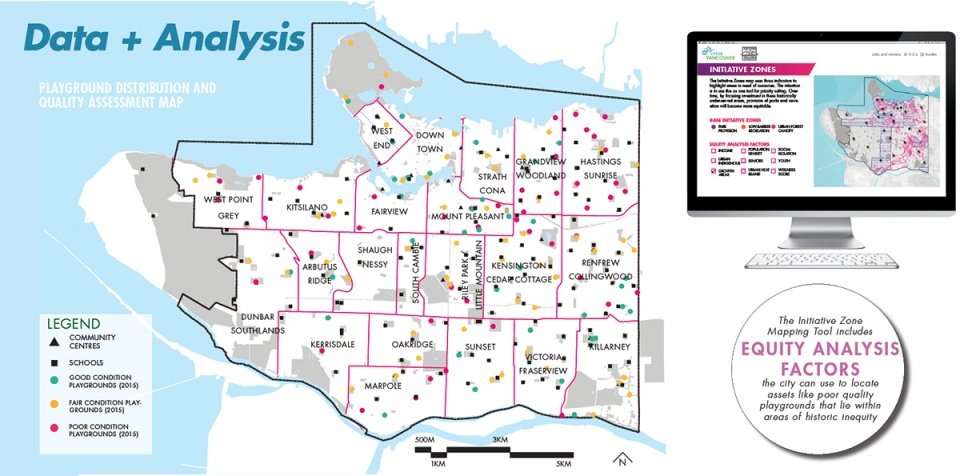
▲资产数据+分析:结合倡议区映射工具,城市如今可以借助三变量测量法得知哪些设施需要进行布局和质量上的改进,以及哪些设施坐落于长期遭受不平等的地区。ASSET DATA + ANALYSIS. Coupled with the Initiative Zone Mapping Tool, the city can now triangulate which amenities need improvements in distribution and quality, and which ones are located in areas of historic inequity.©Design Workshop Inc.
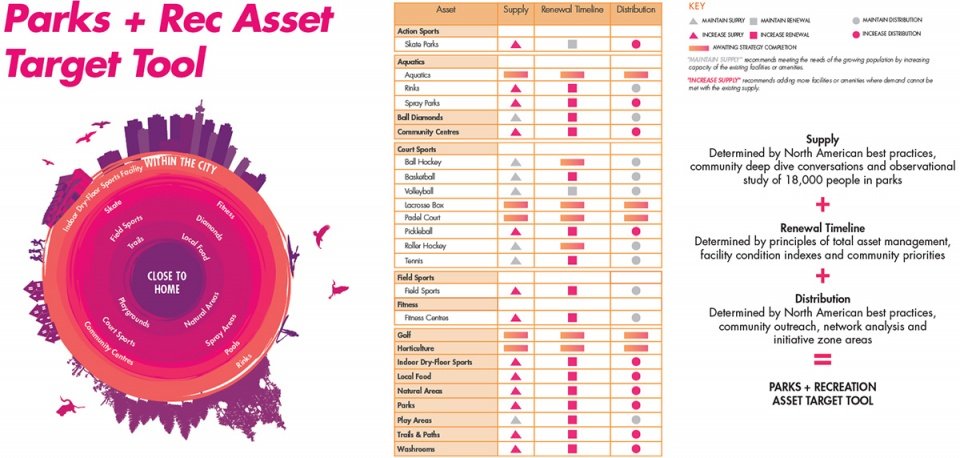
▲公园和休闲用地目标工具:该工具不仅分析了休闲用地的分布,还分析了它们的供给、现状和更新时间表。“深潜”的参与者对公园的1.8万多名使用者进行了观察研究,并与工作人员开展了系列研讨会,促进了最终目标的完善。PARKS AND RECREATION ASSET TARGET TOOL. The tool analyzes not just recreation asset distribution but also their supply, condition and renewal timelines. Deep Dive engagement participants, an observational study of 18,000 people in parks and staff workshops helped refine target goals.©Design Workshop Inc.

▲网络关键问题:由于气候变化的影响,温哥华可能因为海平面上升而失去11%的城市陆地,与此同时,人们需要与自然建立比以往更多的联系。NETWORK CRITICAL QUESTION. Due to impacts of climate change, Vancouver could lose 11 percent of the city’s landmass to sea level rise while needing to connect more people than ever to nature and wellness.©Design Workshop Inc.

▲网络数据+分析:景观设计师带领多个部门共同进行了物理规划练习,以了解城市如何增加动态交通(步行+骑行)、展示生态资产(如隐藏的溪流)并适应气候变化的影响。NETWORK DATA + ANALYSIS. The landscape architect led multiple departments in collaborative physical planning exercises to understand how the city could increase active transportation (walking + biking), reveal ecological assets like hidden streams and adapt to the impacts of climate change.©Design Workshop Inc.
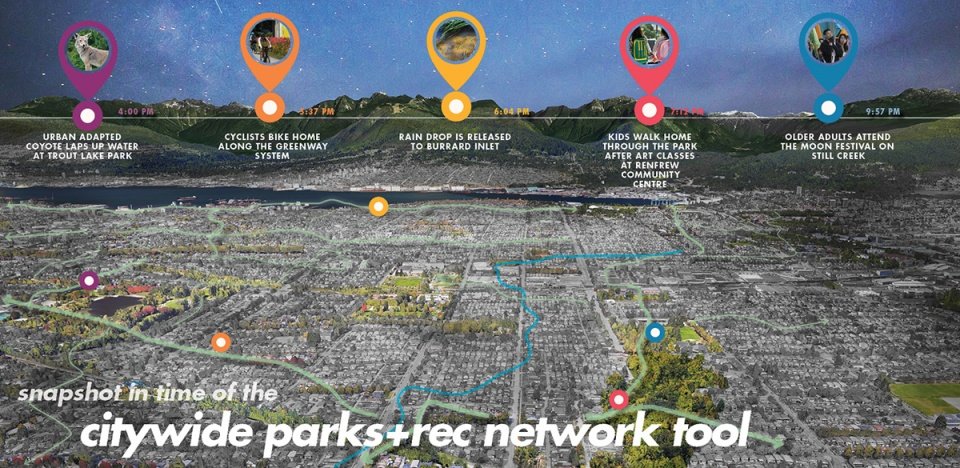
▲网络工具实时快照:伴随着空间的溢价,为公园和休闲区争取额外的土地变得愈发艰难。一个跨越全城市的公园和休闲网络将最终成为我们日常生活的归属地。这其中也包括城市中的野生生物以及自然水流。NETWORK TOOL SNAPSHOT IN TIME. With space at a premium, it is becoming increasingly difficult to secure additional land for parks and recreation areas. A city-wide parks and recreation network is ultimately an encapsulation of our everyday lives, urban wildlife and water flow.©Design Workshop Inc.
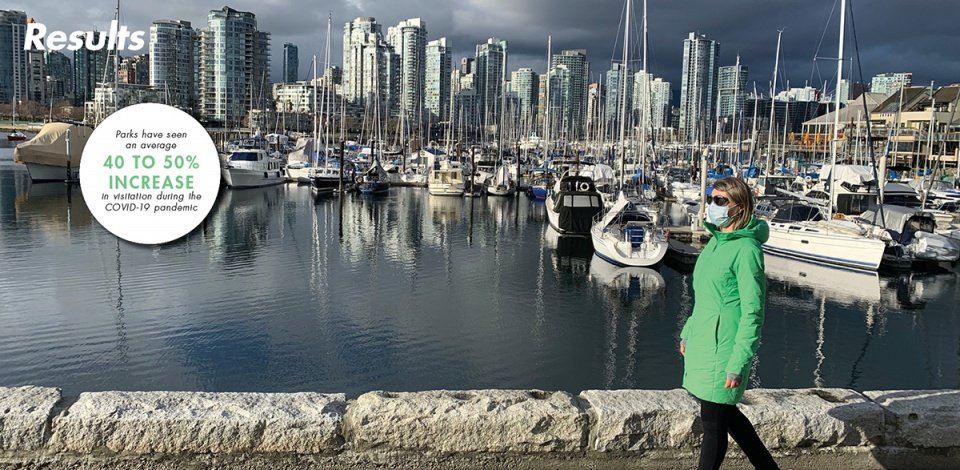
▲结果:随着修复资金的流入,该市已经能够迅速地实施部分试点项目,例如打开22公里的“慢街道”,以及通过VanPlay计划来确定公共开支的优先次序。RESULTS. As COVID-19 recovery funding flows in, the city has been able to pilot quick responses, like opening 22 kilometers of “slow streets,” and is using the VanPlay plan to prioritize public spending.©Design Workshop Inc.
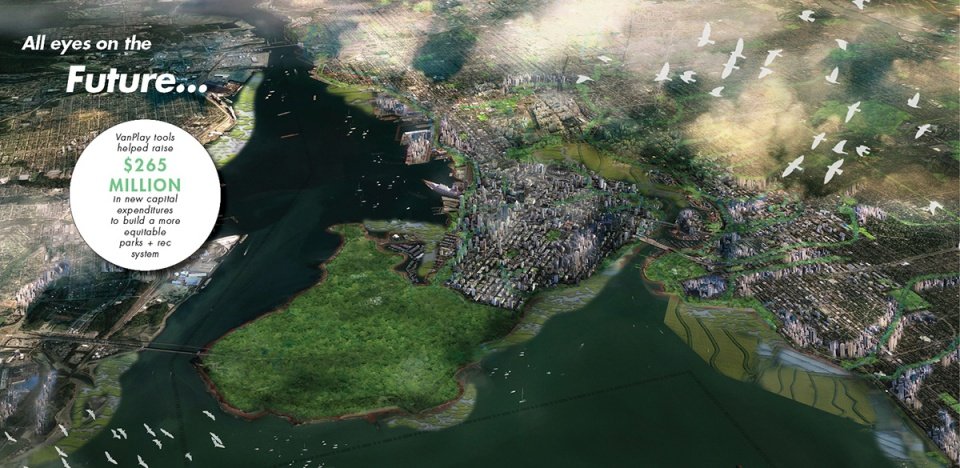
▲着眼未来:VanPlay的工具仅仅是解决规划中存在的系统性不平等问题的一个开始。随着人们比从前更加需要开放的绿色空间,且修复资金已经逐步进入世界各地的城市,拥有透明的决策和设计过程以及明确的价值观念将具有绝对重要的意义。EYES ON THE FUTURE. VanPlay’s tools are a start for addressing systemic inequities in planning. As people seek open spaces more than ever and recovery funding reaches cities worldwide, it is critical to have transparent processes and well-articulated values to prioritize equity.©Design Workshop Inc.
Project Narrative
PROJECT GOALS
VanPlay is centered around three Bold Moves that support the pursuit of equity, connectivity, and access to parks and recreation for the current population and the 125,000 additional city residents anticipated by 2040. As a 44-square-mile land-locked city, Vancouver would have to add a park the size of Stanley Park (1001 acres) to keep up with the projected densification. Helping to address this future and lift up areas of historic inequity, the Bold Moves include three innovative planning tools:
1. Initiative Zone Mapping Tool highlights areas of the city in need of resources and includes equity analysis factors so that projects, programs, and plans can be focused for more equitable provision over time.
2. Parks and Recreation Asset Target Tool considers quantity, quality, capacity, and distribution of parks, natural areas and recreation facilities in the context of a growing population, deferred maintenance and limited resources.
3. Citywide Parks and Recreation Network Tool conceptualizes a 100-year vision of a seamless public realm to connect places, such as community centers, trail systems and large parks together with publicly accessible waterfront lands that expand access regionally and protect ecosystems threatened by impacts of climate change.
SOCIAL DATA AND ANALYSIS SNAPSHOT
Each tool addresses a critical question for the future of parks and recreation and is informed by a strong foundation of previous plans and Vancouver-specific social demographic studies. The team conducted rigorous case studies of global best practices for parks, recreation and equity frameworks. Furthermore, a systemwide observation study (System for Observing Play and Recreation in Communities-SOPARC) took place over six weeks and documented how over 18,000 people used parks in neighborhoods of varying income and diverse backgrounds.
Using these findings and a recent park provision study, the team considered barriers to access that are not normally accounted for—such as busy street crossings, lack of public transportation, and the price of local recreation programs.
HOW DO WE MEASURE AND MAP SPATIAL EQUITY?
While 99 percent of Vancouverites currently live within a 10-minute walk of a greenspace, the quality and condition of these spaces vary widely, particularly in low-income communities. The Initiative Zone Mapping Tool uses three indicators which are layered atop one another at a block-scale resolution to reveal areas of the city that have historically been marginalized for provision of park space, recreation opportunity and green, leafy living environments. This inequity is systemic prejudice and has profound impacts on health and well-being, social capital, and economic development.
The spatial equity tool introduced in VanPlay is powerful in its simplicity and how clearly it shows the locations of priority areas. The areas of the city with low park space per person, that are less green, and that are screaming out for more recreation opportunities are the places where there are people living in small apartments, who perhaps do not have private outdoor space like a backyard in which to quarantine, or do not have access to shade on a hot summer day and are more likely to suffer from heat stroke.
HOW DO WE MEET COMMUNITY NEEDS WHILE PRIORITIZING LIMITED RESOURCES EQUITABLY?
North American cities are struggling to keep up with community needs. In Denver for example, it would take over 400 years at the current level of funding to fill in all the missing sidewalks. Complex, long-standing factors, such as patterns of development and investment, often result in an uneven distribution of amenities across a city.
The Parks and Recreation Asset Target Tool takes stock of the city’s recreational resources (assets), which include park space, sport fields, ice rinks, and urban forests, to name a few. The tool analyzes not just their location but also their condition, renewal timelines, and considers future needs through goal setting to ensure all Vancouverites have access to excellent amenities. The planning team scoured benchmark methodologies including the Trust for Public Land’s ParkScore system as well as total asset management best practices. Coupled with the Initiative Zone Mapping Tool, the city can now triangulate which amenities need improvements in distribution and quality, and which ones are located in areas of historic inequity.
HOW DO WE CONNECT MORE PEOPLE TO NATURE AND STRENGTHEN ENVIRONMENTAL RESILIENCE?
The Citywide Parks and Recreation Network Tool conceptualizes places to play, exercise, and socialize with direct and intuitive connections for pedestrians and cyclists of all ages and abilities in and between these spaces, while providing pathways for the movement of urban wildlife and stormwater. Multiple departments collaborated together to understand how this tool could help Vancouver adapt to the impacts of climate change, including a potential 11 percent loss of the city’s landmass to sea level rise, while adding more opportunities for recreation and wellness through the city.
Because land in Vancouver can cost into the tens of millions of dollars per hectare, buying the land needed for new parks to balance the rapid growth in population is not possible. For this reason, the Network Tool provides a new conceptualization of recreational space, which includes the whole public realm—streetscapes, tree canopy, schools, rooftops, interiors of buildings—with a call for integrated blue-green infrastructure systems that can provide resilience in the face of climate change and global pandemics. From a public health perspective, this network extends into Equity Initiative Zones and helps connect those communities, which typically experience transportation barriers and public health inequities, with more opportunities for walking and cycling to greenspace destinations as part of their daily lives.
30,000 COMMUNITY CONVERSATIONS
Facing a community burned-out with planning fatigue, VanPlay sparked thousands of conversations about the future of parks and recreation using a suite of tools including:
— Inclusive plan graphics that intentionally represented people of different ages, sizes, gender identifications and abilities;
— Videos highlighting the sights, sounds and energy of a day in the life of the Vancouver’s parks and recreation system and helped garner 1 million digital impressions;
— A VanTour that transported an interactive imagination playground to diverse neighborhoods through the city and connected with 4,000 people;
— A series of Smart City community lectures delving into topics including spatial equity;
— Three public online surveys that informed and verified the development of the Bold Moves;
— Deep Dive Workbooks conducted by 270 community-based organizations; and
— A workshop to decolonize the vision plan language with the city’s Reconciliation Planner (VanPlay dovetailed with the city’s ongoing Reconciliation work with Musqueam, Squamish, and Tsleil-Waututh First Nations). The process of decolonization helps reveal hidden language biases.
RESULTS
VanPlay’s Bold Move tools are unique in that they combine a focus on access to parks and recreation with the acknowledgement of systemic prejudice and inequity in the planning of these spaces. The tools are transparent, logical, and approved policy that is ready to be used to prioritize resources.
The tools are currently being used in response to the COVID-19 pandemic as parks and open spaces are more in demand than ever. British Columbia’s parks have seen an average of 40 to 50 percent more visitors than would be typical at this time of year. As recovery funding flows in, the city has been able to pilot quick responses, like opening 22 kilometers of “slow streets,” and is using the VanPlay plan to prioritize public spending.
VanPlay’s Bold Move tools are only a start for addressing systemic inequities in planning. Especially now, as people seek open green spaces more than ever and recovery funding is beginning to reach cities around the world, it is absolutely critical to have transparent processes and well-articulated values when the call for “shovel ready” projects comes in. This project redefines parks and recreation planning standards and delivers model tools for cities to imagine, plan and provide more equitable park and recreation access to their communities.
More:ASLA。Design Workshop, Inc.